

Light Client Specification
This directory contains work-in-progress English and TLA+ specifications for the Light Client protocol. Implementations of the light client can be found in Rust and Go. Light clients are assumed to be initialized once from a trusted source with a trusted header and validator set. The light client protocol allows a client to then securely update its trusted state by requesting and verifying a minimal set of data from a network of full nodes (at least one of which is correct). The light client is decomposed into two main components:- Commit Verification - verify signed headers and associated validator set changes from a single full node, called primary
- Attack Detection - verify commits across multiple full nodes (called secondaries) and detect conflicts (ie. the existence of a lightclient attack)
- Accountability - given evidence for an attack, compute a set of validators that are responsible for it.
Commit Verification
The English specification describes the light client commit verification problem in terms of the temporal properties LCV-DIST-SAFE.1 and LCV-DIST-LIVE.1. Commit verification is assumed to operate within the Cosmos Failure Model, where +2/3 of validators are correct for some time period and validator sets can change arbitrarily at each height. A light client protocol is also provided, including all checks that need to be performed on headers, commits, and validator sets to satisfy the temporal properties - so a light client can continuously synchronize with a blockchain. Clients can skip possibly many intermediate headers by exploiting overlap in trusted and untrusted validator sets. When there is not enough overlap, a bisection routine can be used to find a minimal set of headers that do provide the required overlap. The TLA+ specification ver. 001 is a formal description of the commit verification protocol executed by a client, including the safety and termination, which can be model checked with Apalache. A more detailed TLA+ specification of Light client verification ver. 003 is currently under peer review. TheMC*.tla files contain concrete parameters for the
TLA+ specification, in order to do model checking.
For instance, MC4_3_faulty.tla contains the following parameters
for the nodes, heights, the trusting period, the clock drifts,
correctness of the primary node, and the ratio of the faulty processes:
$DIR and run the following commands:
results.csv should report Deadlock, which means that the algorithm
has terminated and no invariant violation was found.
Similar to 002bmc-apalache-ok.csv,
file 003bmc-apalache-error.csv specifies
the set of experiments that should result in counterexamples:
results.csv should report Error.
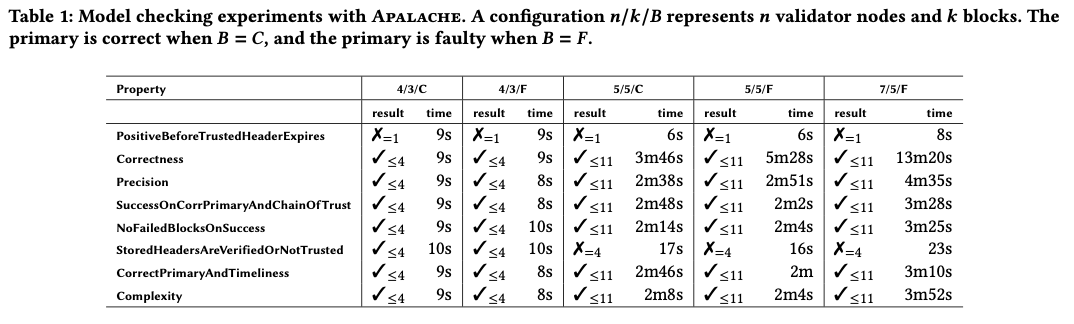
The following table summarizes the experimental results for Light client verification
version 001. The TLA+ properties can be found in the
TLA+ specification.
The experiments were run in an AWS instance equipped with 32GB
RAM and a 4-core Intel® Xeon® CPU E5-2686 v4 @ 2.30GHz CPU.
We write “✗=k” when a bug is reported at depth k, and “✓<=k” when
no bug is reported up to depth k.
Attack Detection
The English specification defines light client attacks (and how they differ from blockchain forks), and describes the problem of a light client detecting these attacks by communicating with a network of full nodes, where at least one is correct. The specification also contains a detection protocol that checks whether the header obtained from the primary via the verification protocol matches corresponding headers provided by the secondaries. If this is not the case, the protocol analyses the verification traces of the involved full nodes and generates evidence of misbehavior that can be submitted to a full node so that the faulty validators can be punished. The TLA+ specification is a formal description of the detection protocol for two peers, including the safety and termination, which can be model checked with Apalache. TheLCD_MC*.tla files contain concrete parameters for the
TLA+ specification,
in order to run the model checker.
For instance, LCD_MC4_4_faulty.tla
contains the following parameters
for the nodes, heights, the trusting period, the clock drifts,
correctness of the nodes, and the ratio of the faulty processes:
$DIR and run the following commands:
results.csv should report Deadlock, which means that the algorithm
has terminated and no invariant violation was found.
Similar to 004bmc-apalache-ok.csv,
file 005bmc-apalache-error.csv specifies
the set of experiments that should result in counterexamples:
results.csv should report Error.
The detailed experimental results are to be added soon.
Accountability
The English specification defines the protocol that is executed on a full node upon receiving attack evidence from a lightclient. In particular, the protocol handles three types of attacks- lunatic
- equivocation
- amnesia