

Validators
Validators are responsible for committing new blocks in the blockchain. These validators participate in the consensus protocol by broadcasting votes which contain cryptographic signatures signed by each validator’s private key. Some Proof-of-Stake consensus algorithms aim to create a “completely” decentralized system where all stakeholders (even those who are not always available online) participate in the committing of blocks. CometBFT has a different approach to block creation. Validators are expected to be online, and the set of validators is permissioned/curated by the ABCI application. Proof-of-stake is not required, but can be implemented on top of CometBFT consensus. That is, validators may be required to post collateral on-chain, off-chain, or may not be required to post any collateral at all. Validators have a cryptographic key-pair and an associated amount of “voting power”. Voting power need not be the same.Becoming a Validator
There are two ways to become validator.- They can be pre-established in the genesis state
- The ABCI app responds to the FinalizeBlock message with changes to the existing validator set.
Setting up a Validator
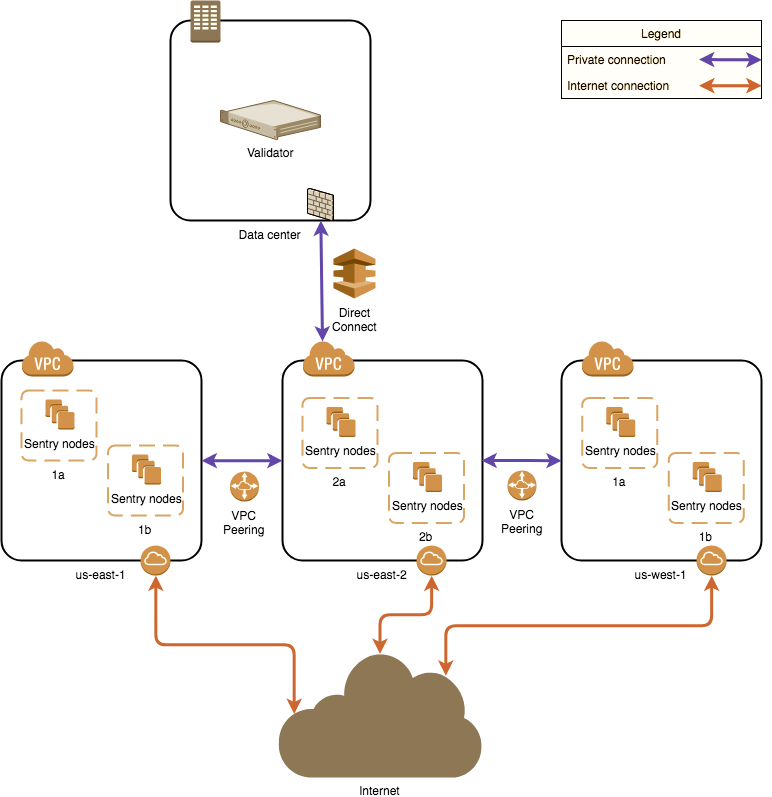
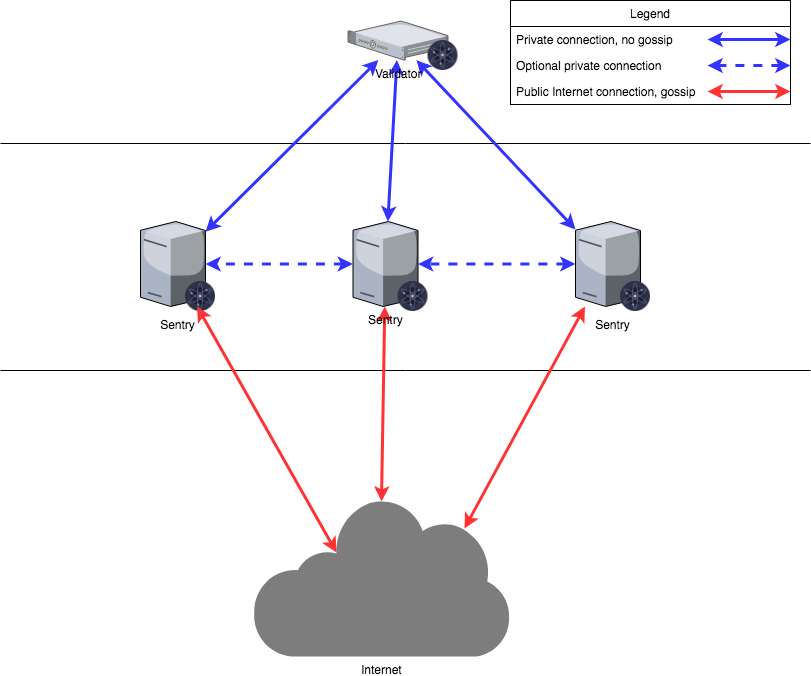
When setting up a validator there are countless ways to configure your setup. This guide is aimed at showing one of them, the sentry node design. This design is mainly for DDoS prevention.Network Layout
Local Configuration
config.toml that may need to be altered.
pex:boolean. This turns the peer exchange reactor on or off for a node. Whenpex=false, only thepersistent_peerslist is available for connection.persistent_peers:a comma separated list ofnodeID@ip:portvalues that define a list of peers that are expected to be online at all times. This is necessary at first startup because by settingpex=falsethe node will not be able to join the network.unconditional_peer_ids:comma separated list of nodeID’s. These nodes will be connected to no matter the limits of inbound and outbound peers. This is useful for when sentry nodes have full address books.private_peer_ids:comma separated list of nodeID’s. These nodes will not be gossiped to the network. This is an important field as you do not want your validator IP gossiped to the network.addr_book_strict:boolean. By default nodes with a routable address will be considered for connection. If this setting is turned off (false), non-routable IP addresses, like addresses in a private network can be added to the address book.double_sign_check_heightint64 height. How many blocks to look back to check existence of the node’s consensus votes before joining consensus When non-zero, the node will panic upon restart if the same consensus key was used to signdouble_sign_check_heightlast blocks. So, validators should stop the state machine, wait for some blocks, and then restart the state machine to avoid panic.
Validator Node Configuration
| Config Option | Setting |
|---|---|
| pex | false |
| persistent_peers | list of sentry nodes |
| private_peer_ids | none |
| unconditional_peer_ids | optionally sentry node IDs |
| addr_book_strict | false |
| double_sign_check_height | 10 |
pex=false so it does not gossip to the entire network. The persistent peers will be your sentry nodes. Private peers can be left empty as the validator is not trying to hide who it is communicating with. Setting unconditional peers is optional for a validator because they will not have a full address books.
Sentry Node Configuration
| Config Option | Setting |
|---|---|
| pex | true |
| persistent_peers | validator node, optionally other sentry nodes |
| private_peer_ids | validator node ID |
| unconditional_peer_ids | validator node ID, optionally sentry node IDs |
| addr_book_strict | false |
pex=true. The persistent peers of a sentry node will be the validator, and optionally other sentry nodes. The sentry nodes should make sure that they do not gossip the validator’s ip, to do this you must put the validators nodeID as a private peer. The unconditional peer IDs will be the validator ID and optionally other sentry nodes.
Note: Do not forget to secure your node’s firewalls when setting them up.More Information can be found at these links:
Validator keys
Protecting a validator’s consensus key is the most important factor to take in when designing your setup. The key that a validator is given upon creation of the node is called a consensus key, it has to be online at all times in order to vote on blocks. It is not recommended to merely hold your private key in the default json file (priv_validator_key.json). Fortunately, the Interchain Foundation has worked with a team to build a key management server for validators. You can find documentation on how to use it here, it is used extensively in production. You are not limited to using this tool, there are also HSMs, there is not a recommended HSM.
Currently CometBFT uses Ed25519 keys which are widely supported across the security sector and HSMs.