

CometBFT QA Results v0.38.x
This iteration of the QA was run on CometBFTv0.38.0-alpha.2, the second
v0.38.x version from the CometBFT repository.
The changes with respect to the baseline, v0.37.0-alpha.3 from Feb 21, 2023,
include the introduction of the FinalizeBlock method to complete the full
range of ABCI++ functionality (ABCI 2.0), and other several improvements
described in the
CHANGELOG.
Issues discovered
- (critical, fixed) #539 and #546 - This bug causes the proposer to crash in
PrepareProposalbecause it does not have extensions while it should. This happens mainly when the proposer was catching up. - (critical, fixed) #562 - There were several bugs in the metrics-related logic that were causing panics when the testnets were started.
200 Node Testnet
As in other iterations of our QA process, we have used a 200-node network as testbed, plus nodes to introduce load and collect metrics.Saturation point
As in previous iterations of our QA experiments, we first find the transaction load on which the system begins to show a degraded performance. Then we run the experiments with the system subjected to a load slightly under the saturation point. The method to identify the saturation point is explained here and its application to the baseline is described here. The following table summarizes the results for the different experiments (extracted fromv038_report_tabbed.txt). The X axis
(c) is the number of connections created by the load runner process to the
target node. The Y axis (r) is the rate or number of transactions issued per
second.
| c=1 | c=2 | c=4 | |
|---|---|---|---|
| r=200 | 17800 | 33259 | 33259 |
| r=400 | 35600 | 41565 | 41384 |
| r=800 | 36831 | 38686 | 40816 |
| r=1600 | 40600 | 45034 | 39830 |
c=1,r=400 and c=2,r=200. Entries in the diagonal have
the same amount of transaction load, so we can consider them equivalent. For the
chosen diagonal, the expected number of processed transactions is 1 * 400 tx/s * 89 s = 35600.
(Note that we use 89 out of 90 seconds of the experiment because the last transaction batch
coincides with the end of the experiment and is thus not sent.) The experiments in the diagonal
below expect double that number, that is, 1 * 800 tx/s * 89 s = 71200, but the
system is not able to process such load, thus it is saturated.
Therefore, for the rest of these experiments, we chose c=1,r=400 as the
configuration. We could have chosen the equivalent c=2,r=200, which is the same
used in our baseline version, but for simplicity we decided to use the one with
only one connection.
Also note that, compared to the previous QA tests, we have tried to find the
saturation point within a higher range of load values for the rate r. In
particular we run tests with r equal to or above 200, while in the previous
tests r was 200 or lower. In particular, for our baseline version we didn’t
run the experiment on the configuration c=1,r=400.
For comparison, this is the table with the baseline version, where the
saturation point is beyond the diagonal defined by r=200,c=2 and r=100,c=4.
| c=1 | c=2 | c=4 | |
|---|---|---|---|
| r=25 | 2225 | 4450 | 8900 |
| r=50 | 4450 | 8900 | 17800 |
| r=100 | 8900 | 17800 | 35600 |
| r=200 | 17800 | 35600 | 38660 |
Latencies
The following figure plots the latencies of the experiment carried out with the configurationc=1,r=400.
 .
For reference, the following figure shows the latencies of one of the
experiments for
.
For reference, the following figure shows the latencies of one of the
experiments for c=2,r=200 in the baseline.

Prometheus Metrics on the Chosen Experiment
This section further examines key metrics for this experiment extracted from Prometheus data regarding the chosen experiment with configurationc=1,r=400.
Mempool Size
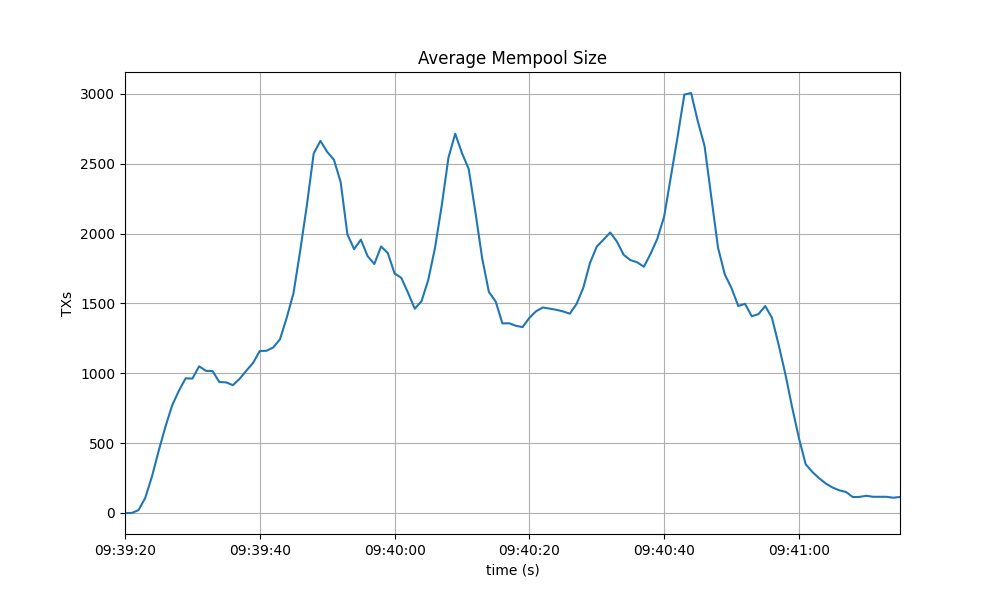
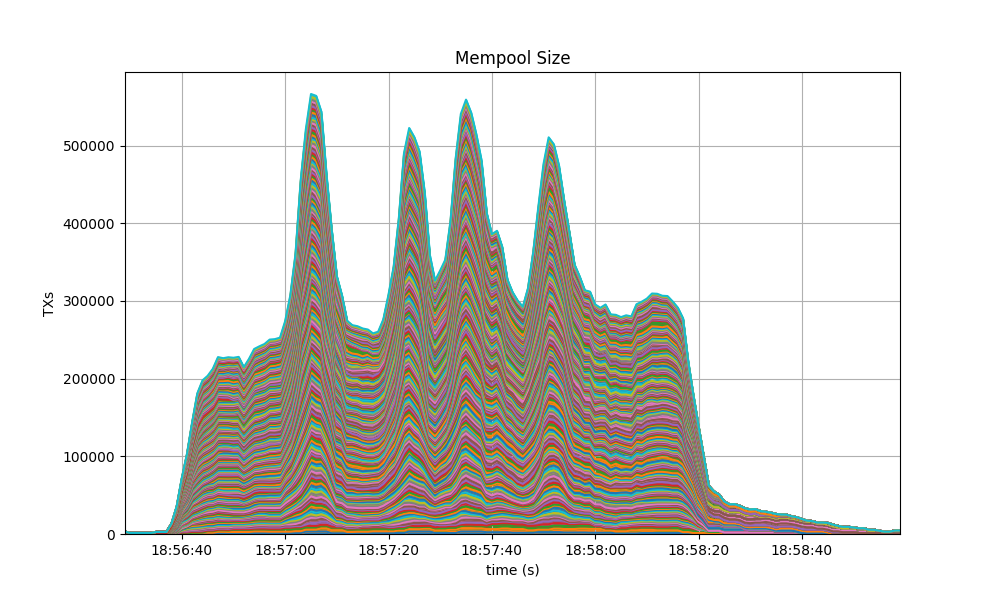
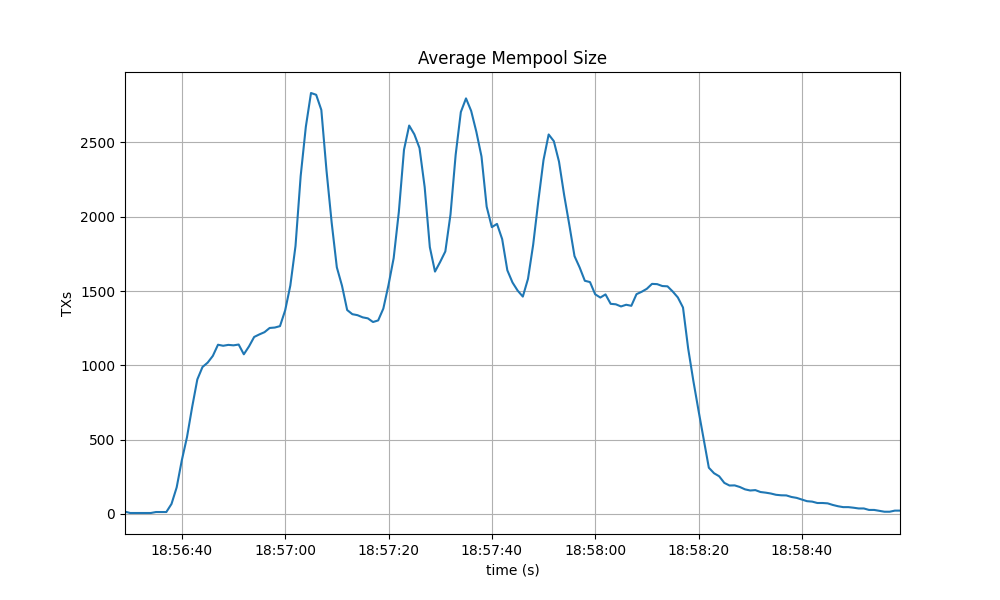
The mempool size, a count of the number of transactions in the mempool, was shown to be stable and homogeneous at all full nodes. It did not exhibit any unconstrained growth. The plot below shows the evolution over time of the cumulative number of transactions inside all full nodes’ mempools at a given time.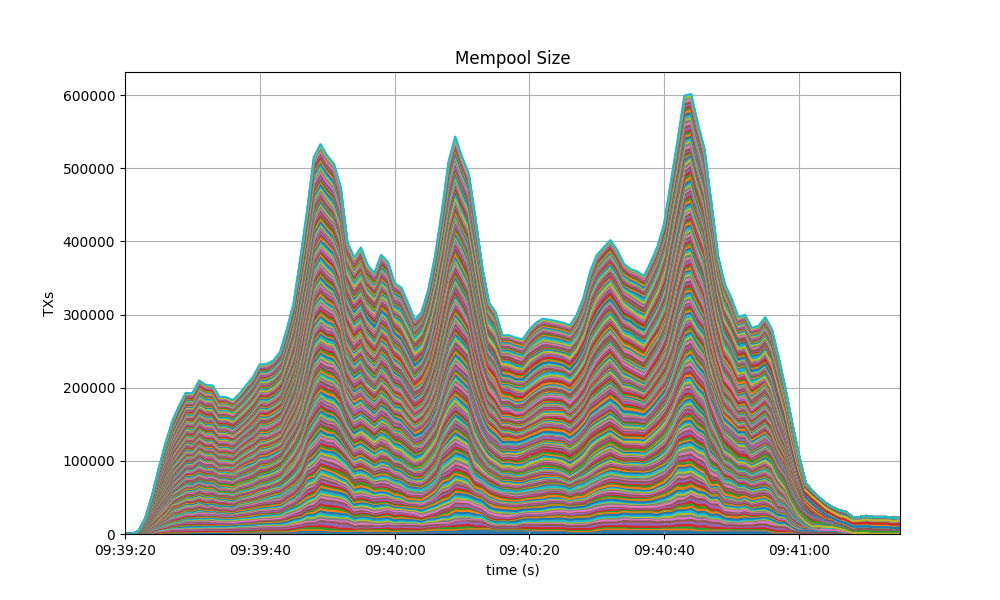
Peers
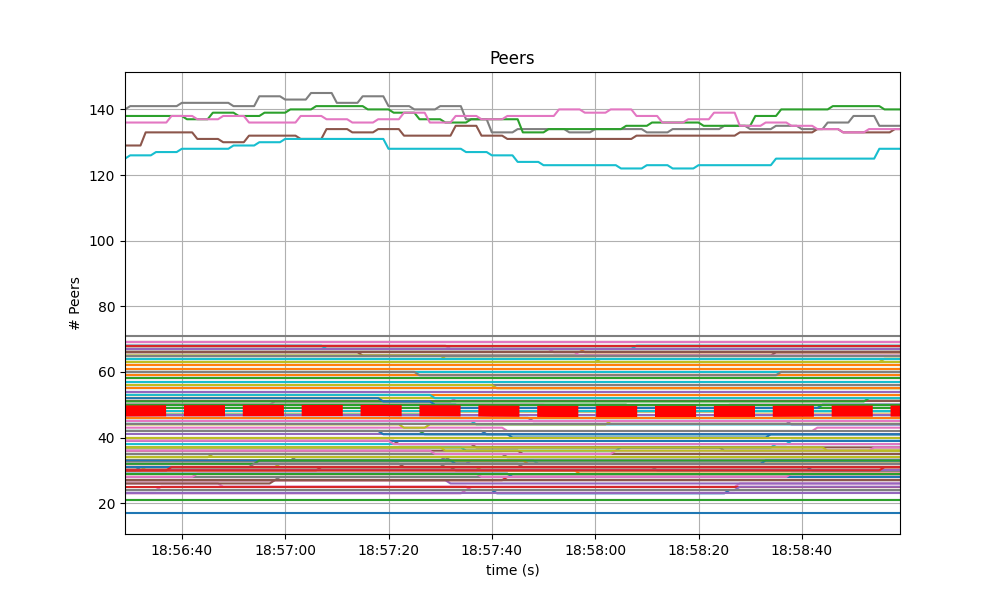
The number of peers was stable at all nodes. It was higher for the seed nodes (around 140) than for the rest (between 20 and 70 for most nodes). The red dashed line denotes the average value.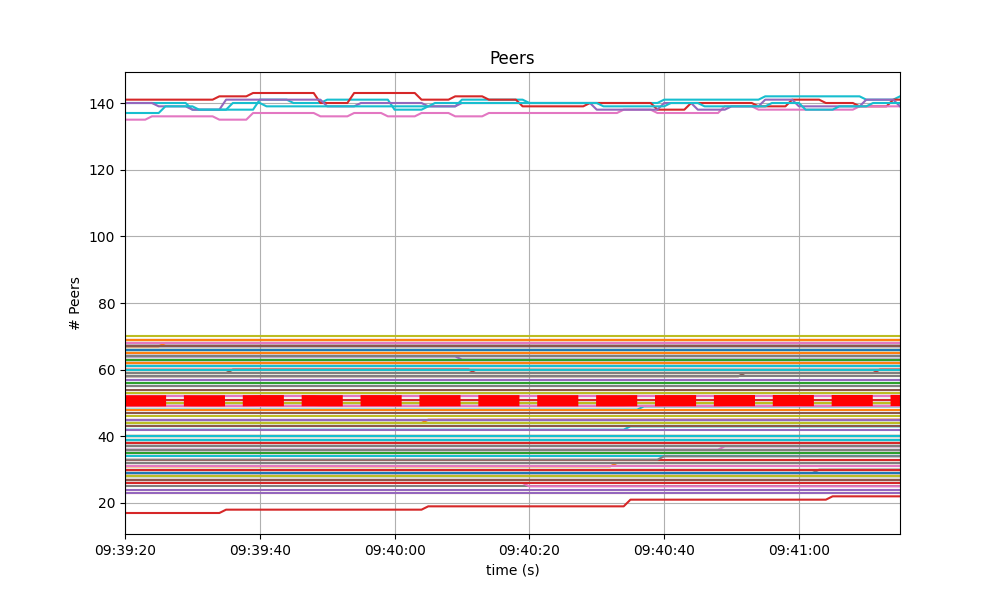
Consensus Rounds per Height
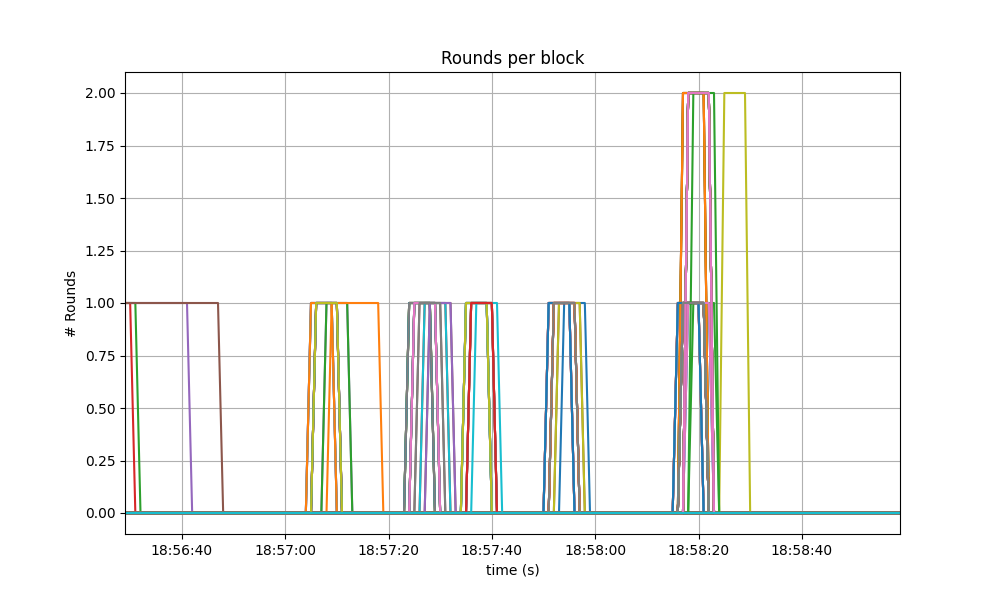
Most heights took just one round, that is, round 0, but some nodes needed to advance to round 1.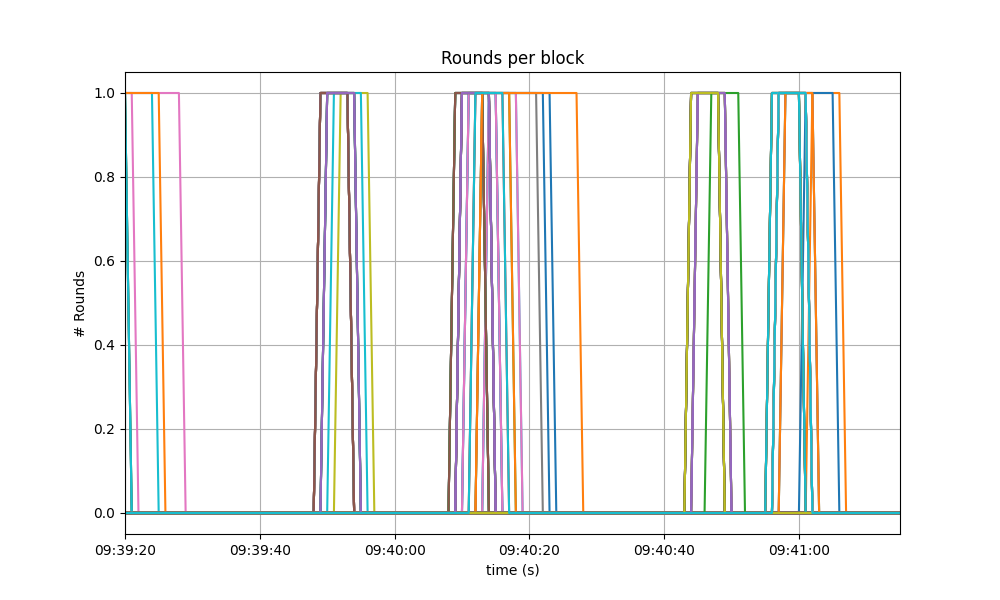
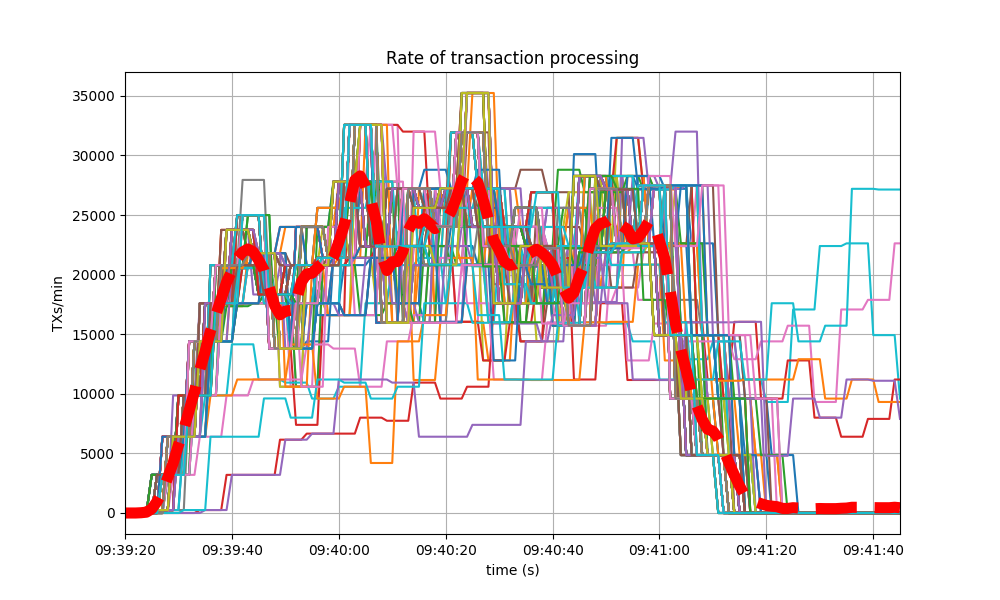
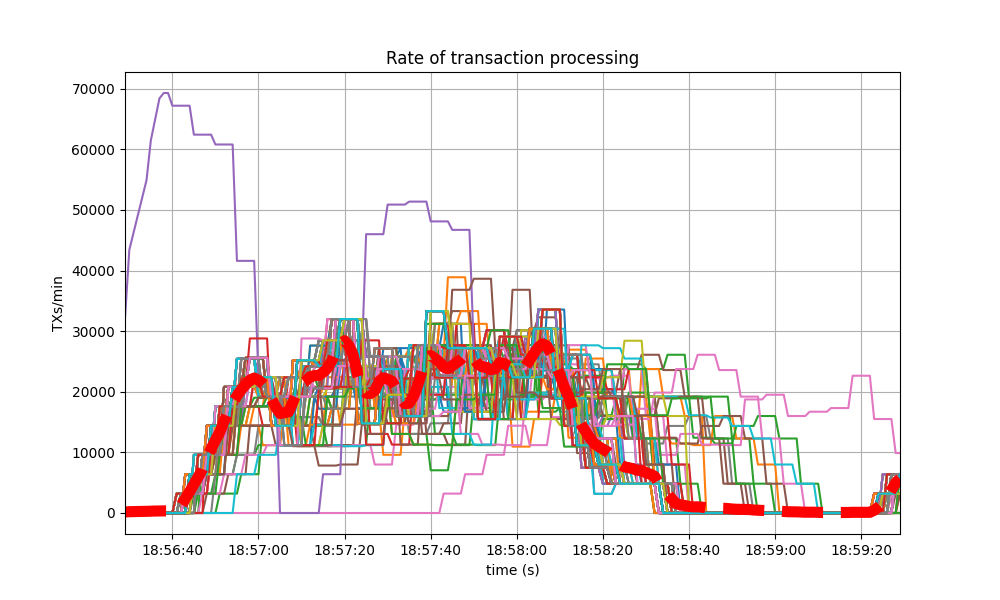
Blocks Produced per Minute, Transactions Processed per Minute
The following plot shows the rate in which blocks were created, from the point of view of each node. That is, it shows when each node learned that a new block had been agreed upon.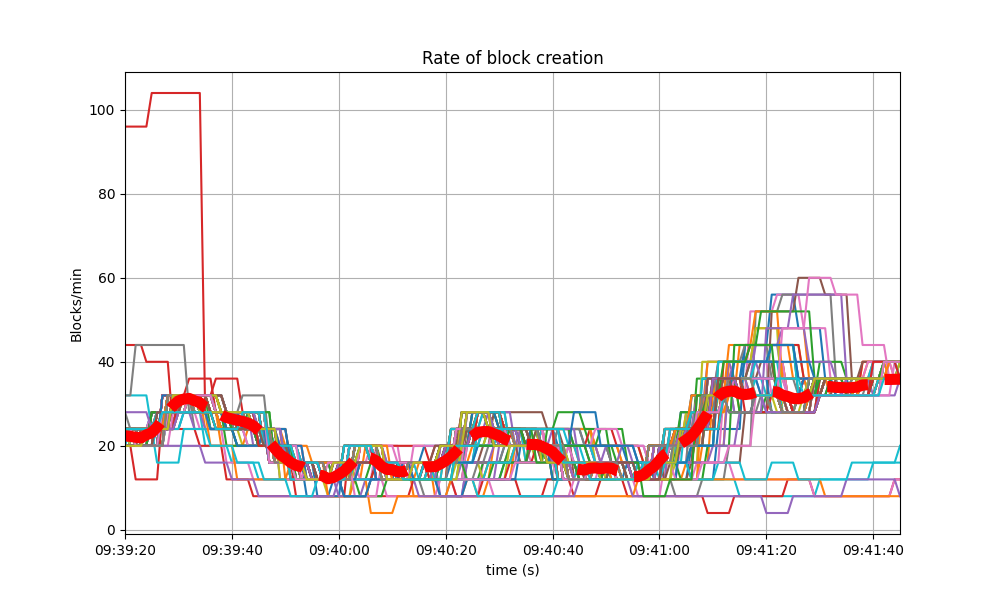

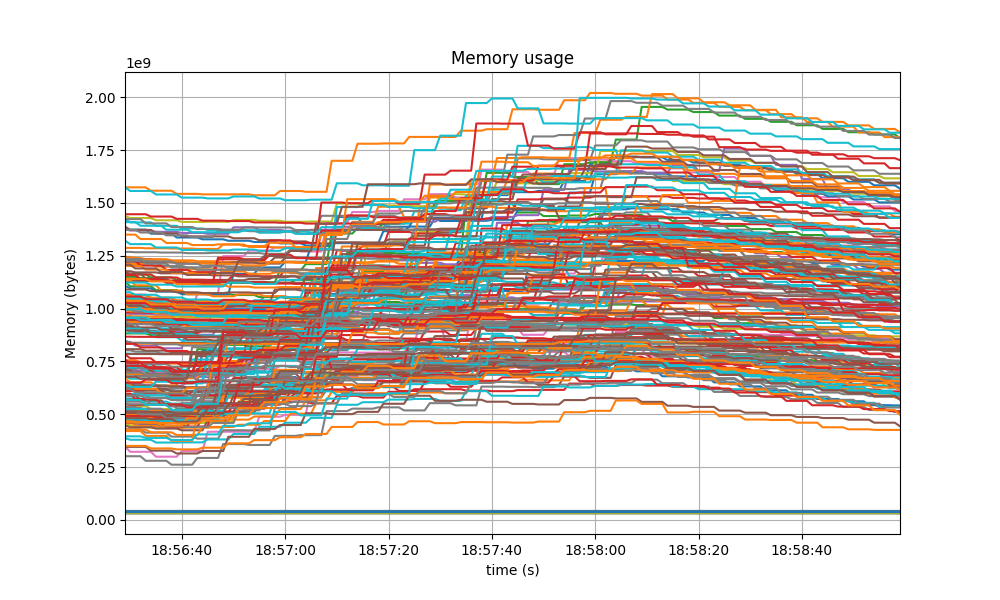
Memory Resident Set Size
The following graph shows the Resident Set Size of all monitored processes, with maximum memory usage of 1.6GB, slightly lower than the baseline shown after.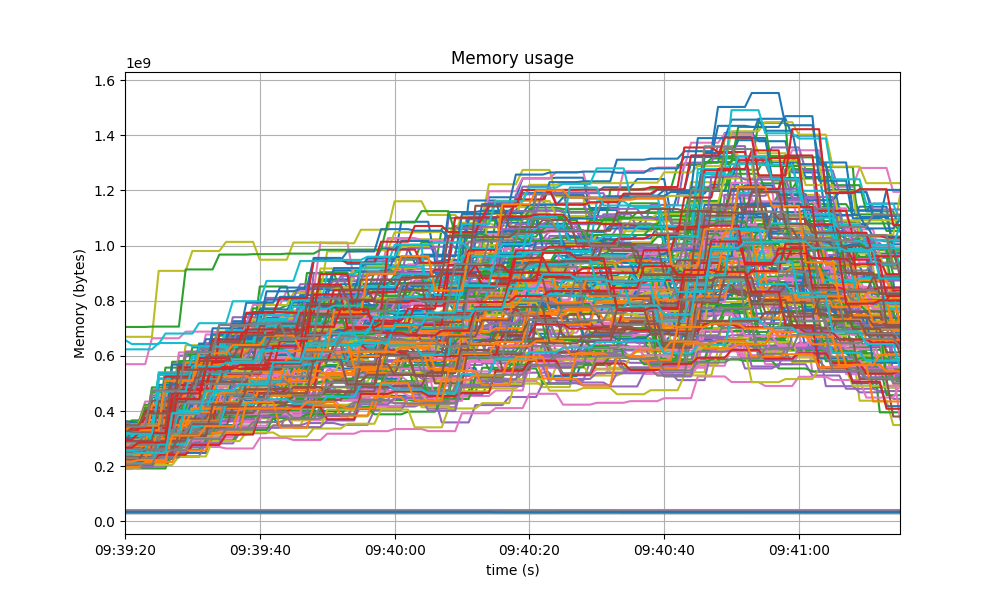
CPU utilization
Comparison to baseline
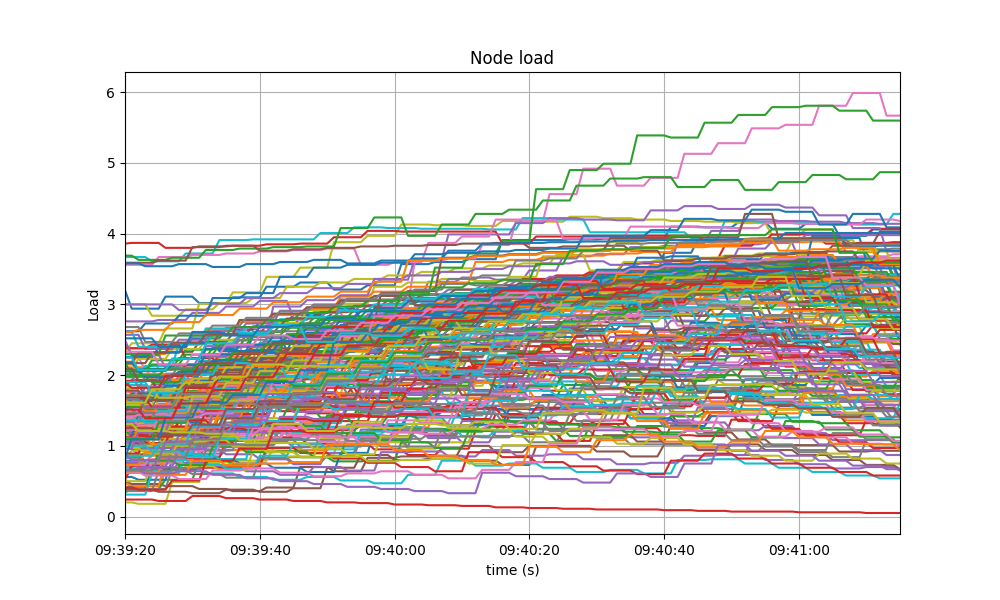
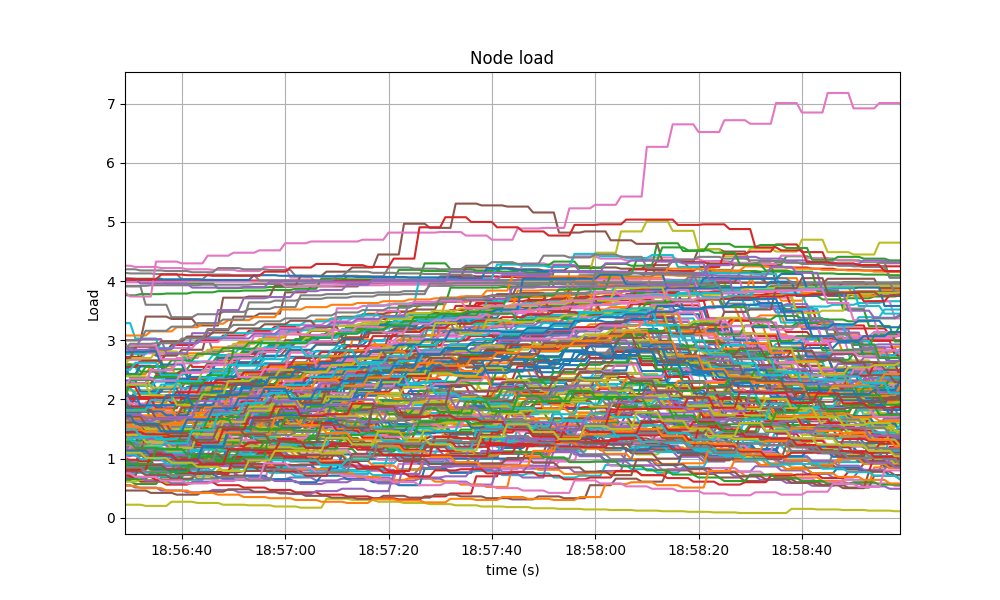
The best metric from Prometheus to gauge CPU utilization in a Unix machine isload1, as it usually appears in the output of
top.
The load is contained below 5 on most nodes, as seen in the following graph.
Impact of vote extension signature verification
It is important to notice that the baseline (v0.37.x) does not implement vote extensions,
whereas the version under test (v0.38.0-alpha.2) does implement them, and they are
configured to be activated since height 1.
The e2e application used in these tests verifies all received vote extension signatures (up to 175)
twice per height: upon PrepareProposal (for sanity) and upon ProcessProposal (to demonstrate how
real applications can do it).
The fact that there is no noticeable difference in the CPU utilization plots of
the baseline and v0.38.0-alpha.2 means that re-verifying up 175 vote extension signatures twice
(besides the initial verification done by CometBFT when receiving them from the network)
has no performance impact in the current version of the system: the bottlenecks are elsewhere.
Thus, we should focus on optimizing other parts of the system: the ones that cause the current
bottlenecks (mempool gossip duplication, leaner proposal structure, optimized consensus gossip).
Test Results
The comparison against the baseline results show that both scenarios had similar numbers and are therefore equivalent. A conclusion of these tests is shown in the following table, along with the commit versions used in the experiments.| Scenario | Date | Version | Result |
|---|---|---|---|
| 200-node | 2023-05-21 | v0.38.0-alpha.2 (1f524d12996204f8fd9d41aa5aca215f80f06f5e) | Pass |
Rotating Node Testnet
We usec=1,r=400 as load, which can be considered a safe workload, as it was close to (but below)
the saturation point in the 200 node testnet. This testnet has less nodes (10 validators and 25 full nodes).
Importantly, the baseline considered in this section is v0.37.0-alpha.2 (Tendermint Core),
which is different from the one used in the previous section.
The reason is that this testnet was not re-tested for v0.37.0-alpha.3 (CometBFT),
since it was not deemed necessary.
Unlike in the baseline tests, the version of CometBFT used for these tests is not affected by #9539,
which was fixed right after having run rotating testnet for v0.37.
As a result, the load introduced in this iteration of the test is higher as transactions do not get rejected.
Latencies
The plot of all latencies can be seen here.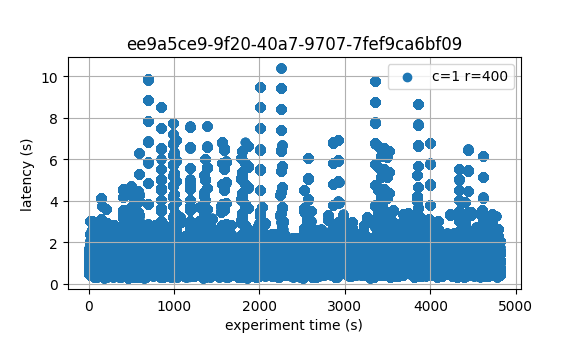
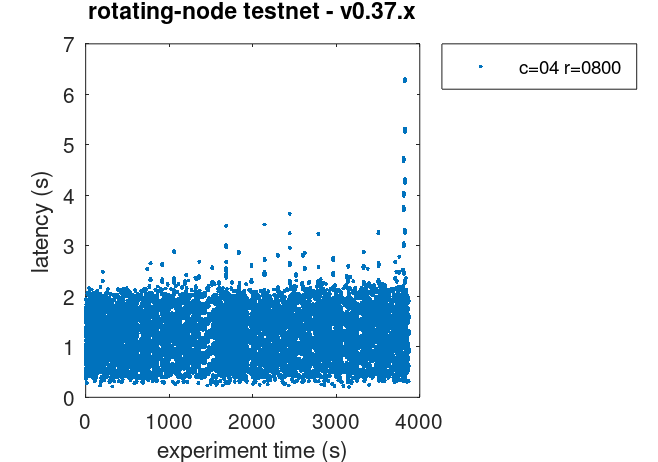
CheckTx).
Prometheus Metrics
The set of metrics shown here roughly match those shown on the baseline (v0.37) for the same experiment.
We also show the baseline results for comparison.
Blocks and Transactions per minute
This following plot shows the blocks produced per minute.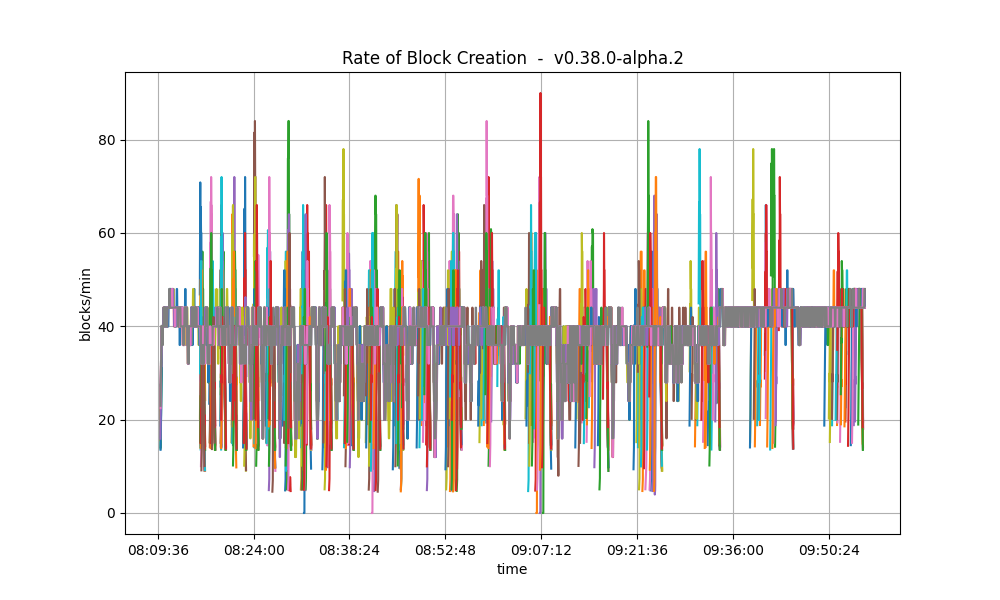
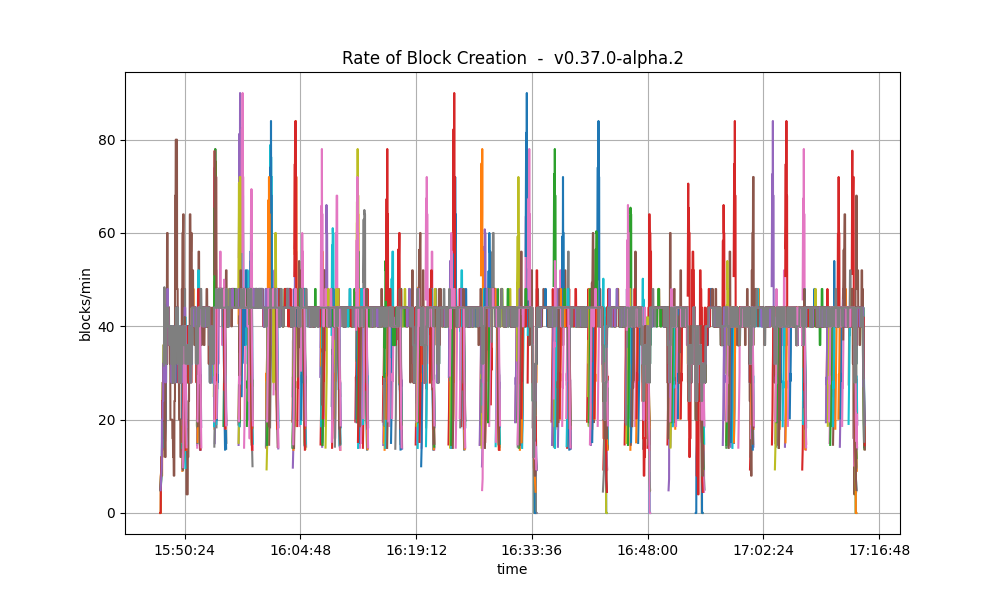
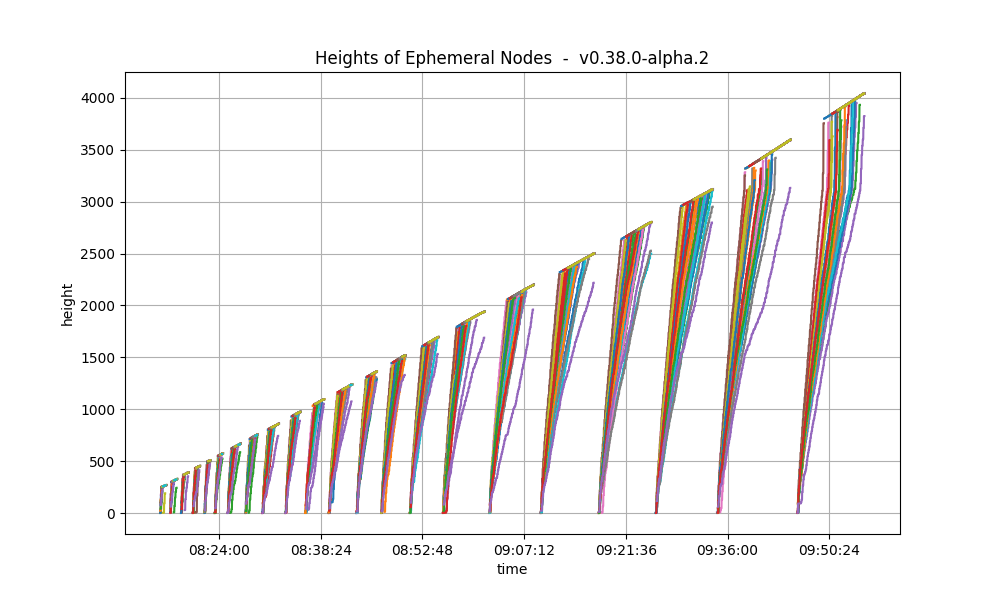
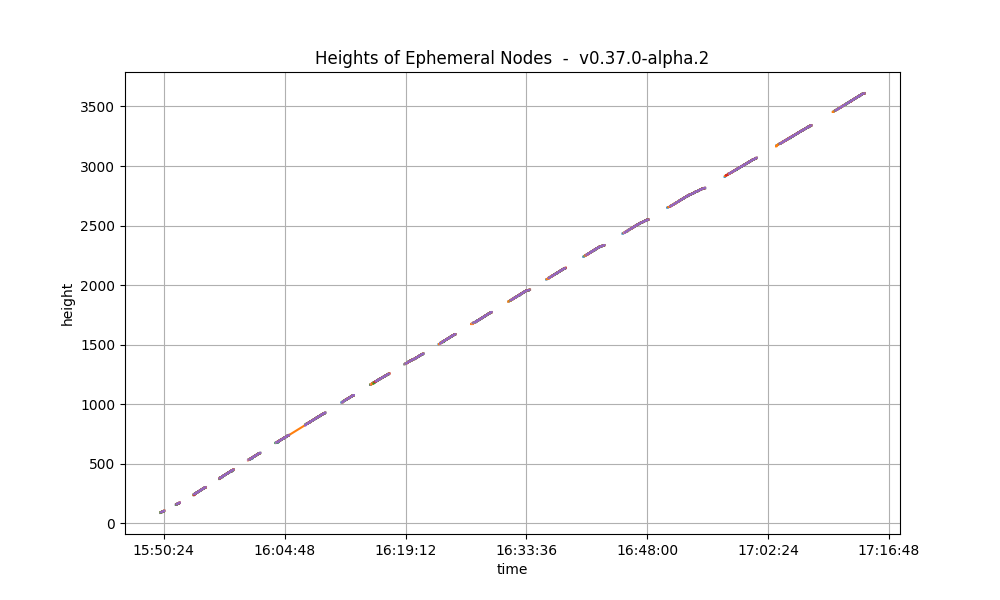
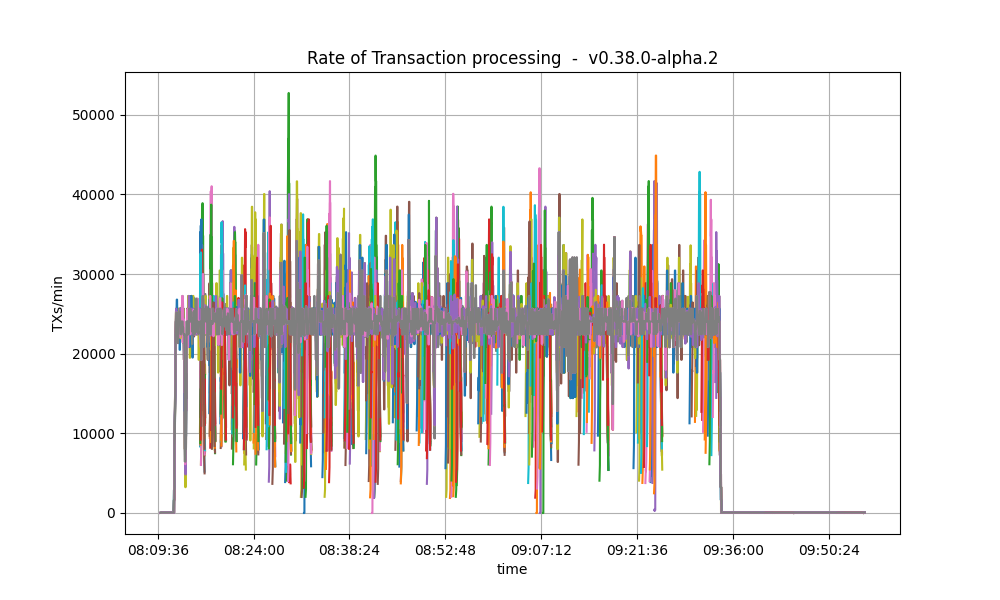
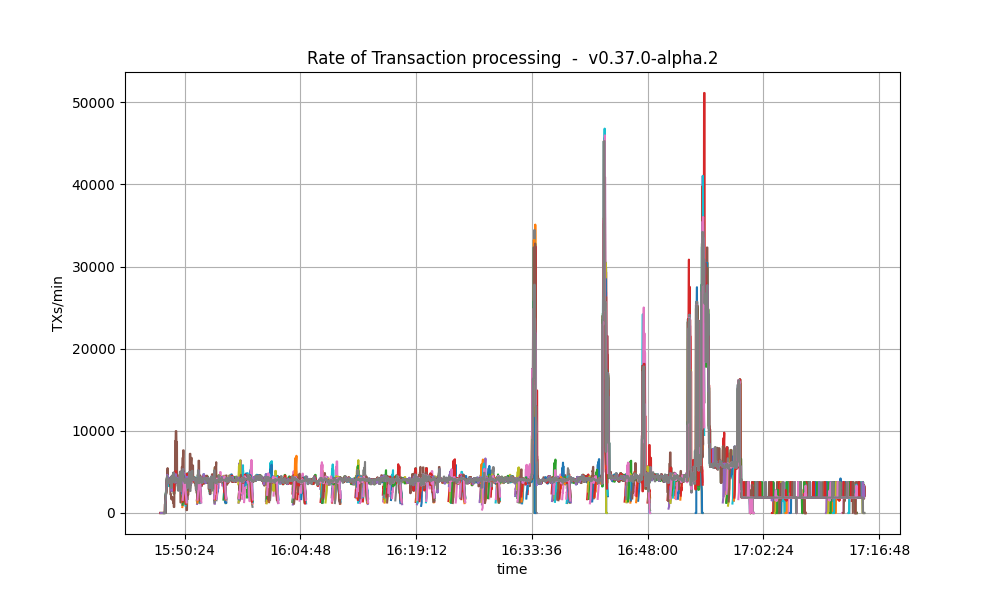
CheckTx rejected most transactions
produced by the load runner.
Peers
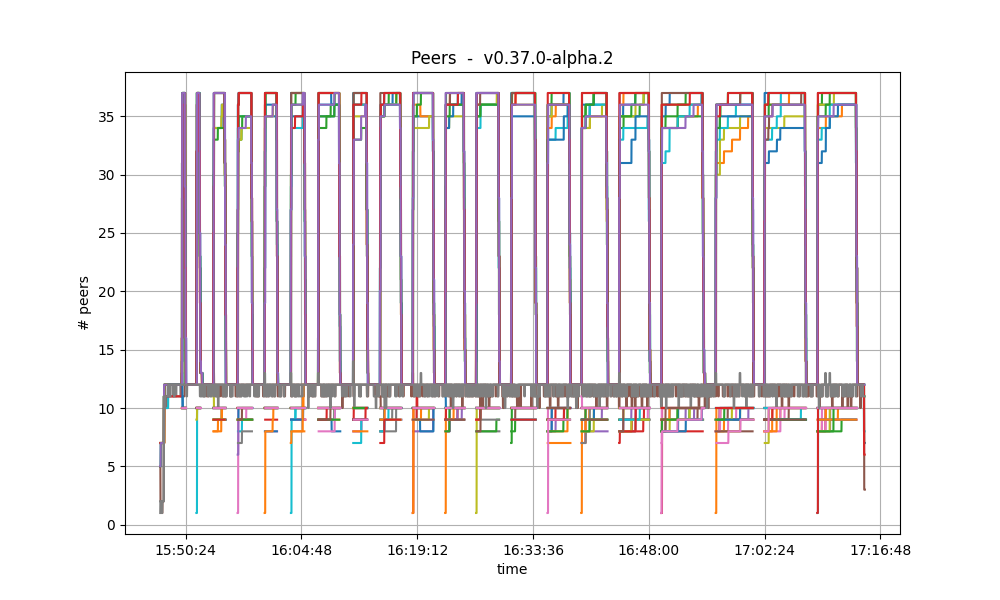
The plot below shows the evolution of the number of peers throughout the experiment.
Memory Resident Set Size
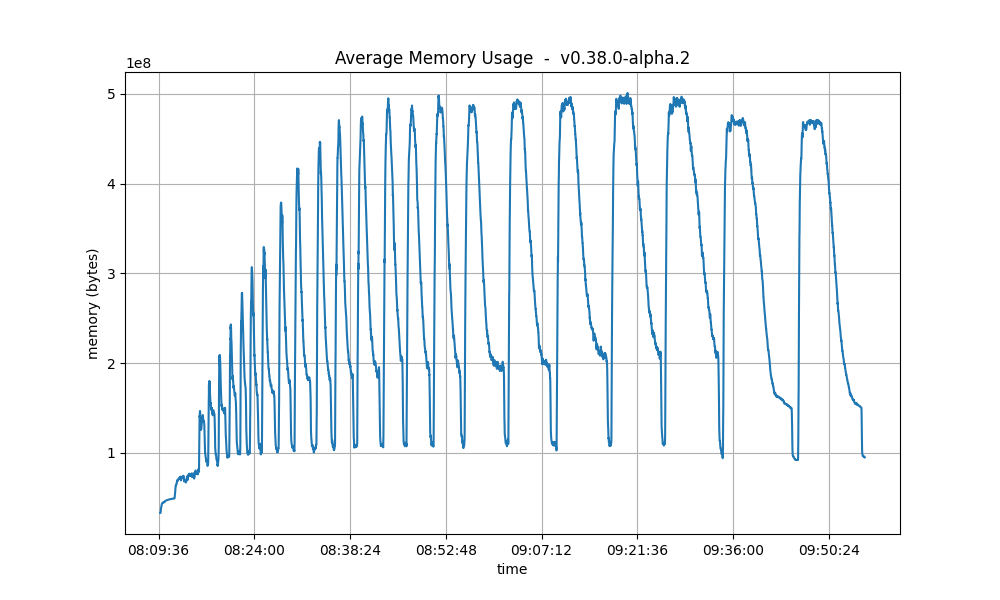
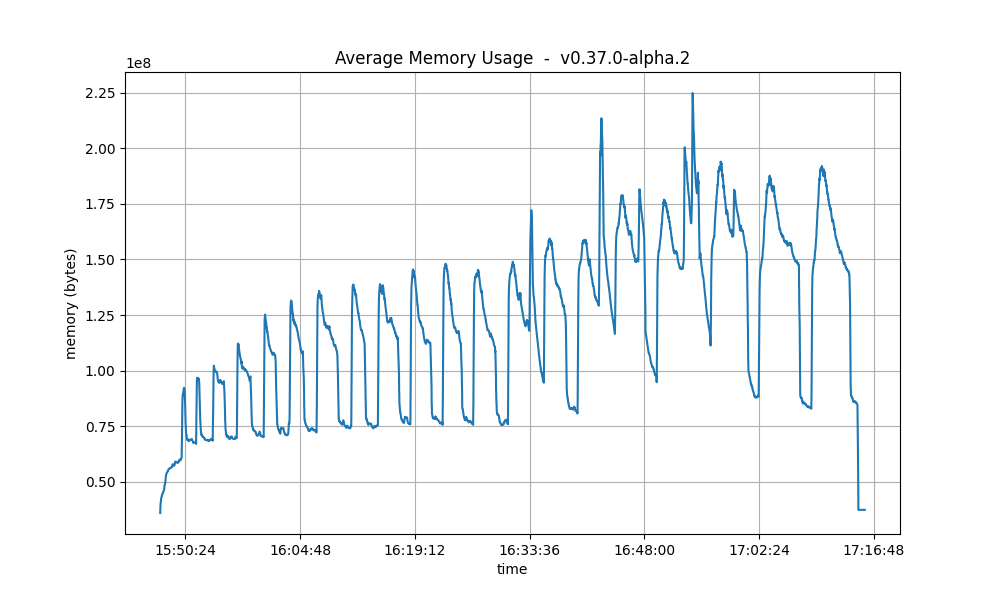
The average Resident Set Size (RSS) over all processes is notably bigger onv0.38.0-alpha.2 than on the baseline.
The reason for this is, again, the fact that CheckTx was rejecting most transactions submitted on the baseline
and therefore the overall transaction load was lower on the baseline.
This is consistent with the difference seen in the transaction rate plots
in the previous section.
CPU utilization
The plots show metricload1 for all nodes for v0.38.0-alpha.2 and for the baseline.
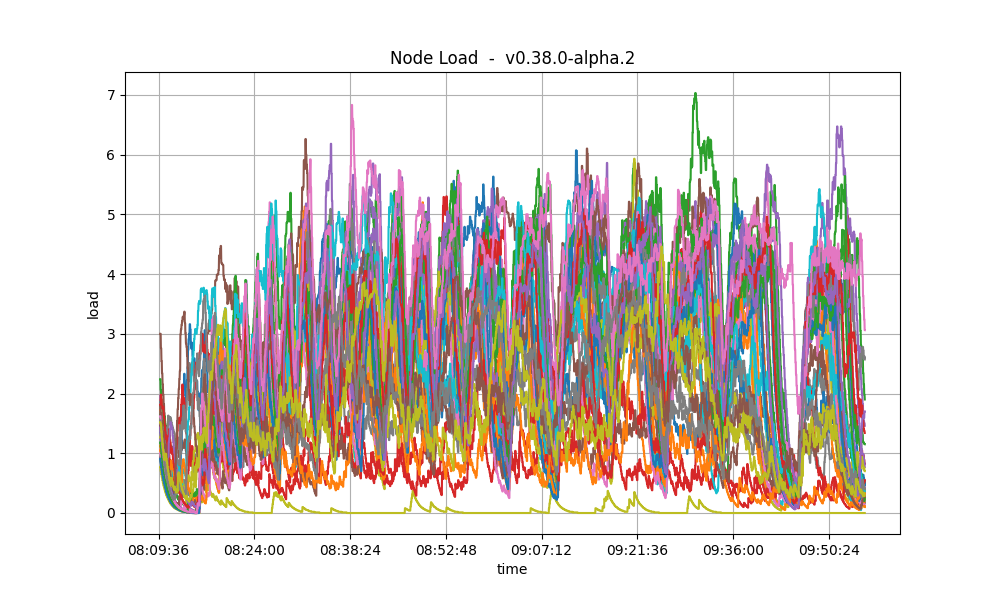
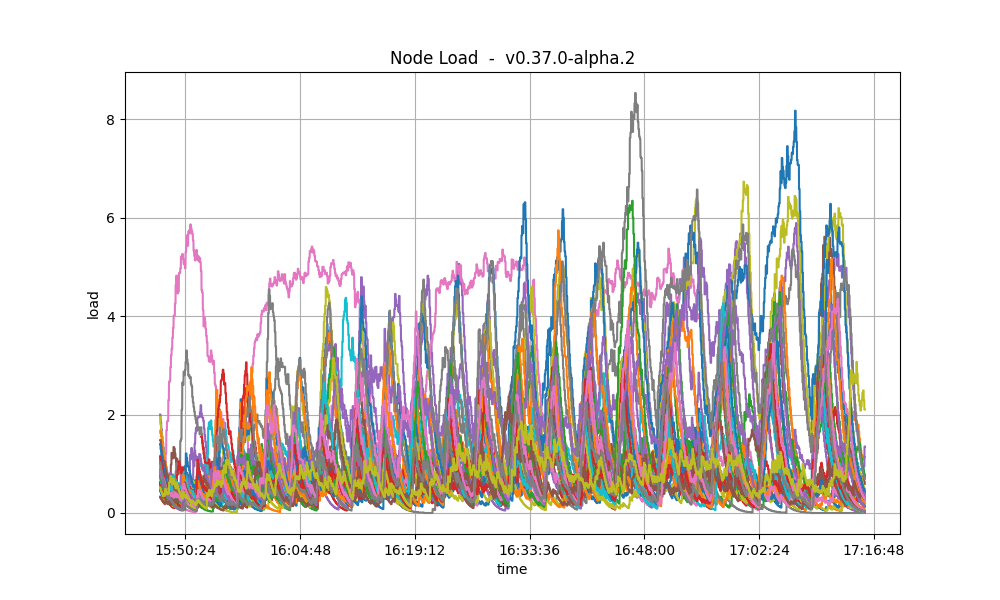
v0.38.0-alpha.2 on average because of the bigger
number of transactions processed per minute as compared to the baseline.
Test Result
| Scenario | Date | Version | Result |
|---|---|---|---|
| Rotating | 2023-05-23 | v0.38.0-alpha.2 (e9abb116e29beb830cf111b824c8e2174d538838) | Pass |
Vote Extensions Testbed
In this testnet we evaluate the effect of varying the sizes of vote extensions added to pre-commit votes on the performance of CometBFT. The test uses the Key/Value store in our [end-to-end] test framework, which has the following simplified flow:- When validators send their pre-commit votes to a block of height , they first extend the vote as they see fit in
ExtendVote. - When a proposer for height creates a block to propose, in
PrepareProposal, it prepends the transactions with a special transaction, which modifies a reserved key. The transaction value is derived from the extensions from height ; in this example, the value is derived from the vote extensions and includes the set itself, hexa encoded as string. - When a validator sends their pre-vote for the block proposed in , they first double check in
ProcessProposalthat the special transaction in the block was properly built by the proposer. - When validators send their pre-commit for the block proposed in , they first extend the vote, and the steps repeat for heights and so on.
vote_extension_size.
Hence, two effects are seen on the network.
First, pre-commit vote message sizes will increase by the specified vote_extension_size and, second, block messages will increase by twice vote_extension_size, given then hexa encoding of extensions, times the number of extensions received, i.e. at least 2/3 of 175.
All tests were performed on commit d5baba237ab3a04c1fd4a7b10927ba2e6a2aab27, which corresponds to v0.38.0-alpha.2 plus commits to add the ability to vary the vote extension sizes to the test application.
Although the same commit is used for the baseline, in this configuration the behavior observed is the same as in the “vanilla” v0.38.0-alpha.2 test application, that is, vote extensions are 8-byte integers, compressed as variable size integers instead of a random sequence of size vote_extension_size.
The following table summarizes the test cases.
| Name | Extension Size (bytes) | Date |
|---|---|---|
| baseline | 8 (varint) | 2023-05-26 |
| 2k | 2048 | 2023-05-29 |
| 4k | 4094 | 2023-05-29 |
| 8k | 8192 | 2023-05-26 |
| 16k | 16384 | 2023-05-26 |
| 32k | 32768 | 2023-05-26 |
Latency
The following figures show the latencies observed on each of the 5 runs of each experiment; the redline shows the average of each run. It can be easily seen from these graphs that the larger the vote extension size, the more latency varies and the more common higher latencies become. Even in the case of extensions of size 2k, the mean latency goes from below 5s to nearly 10s. Baseline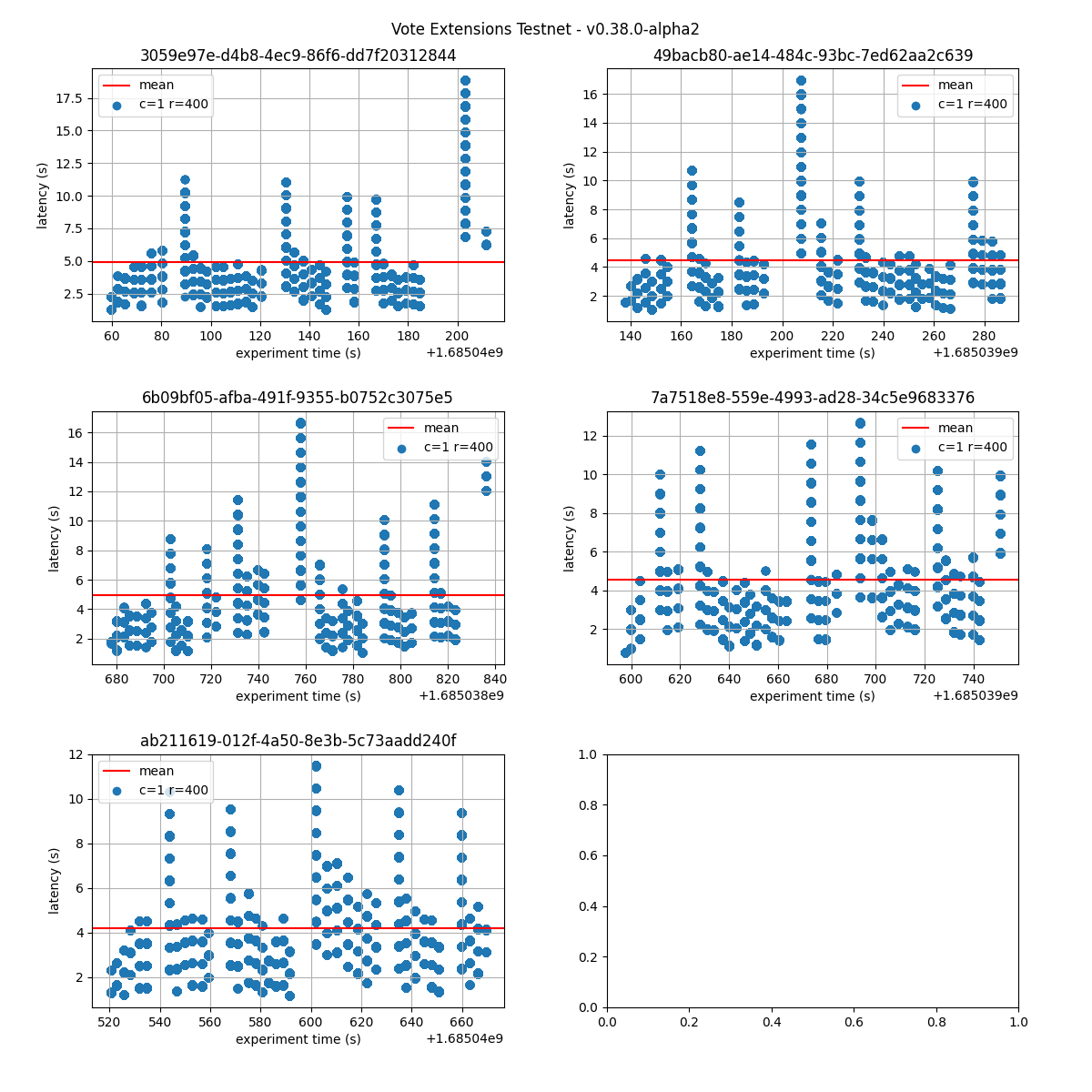
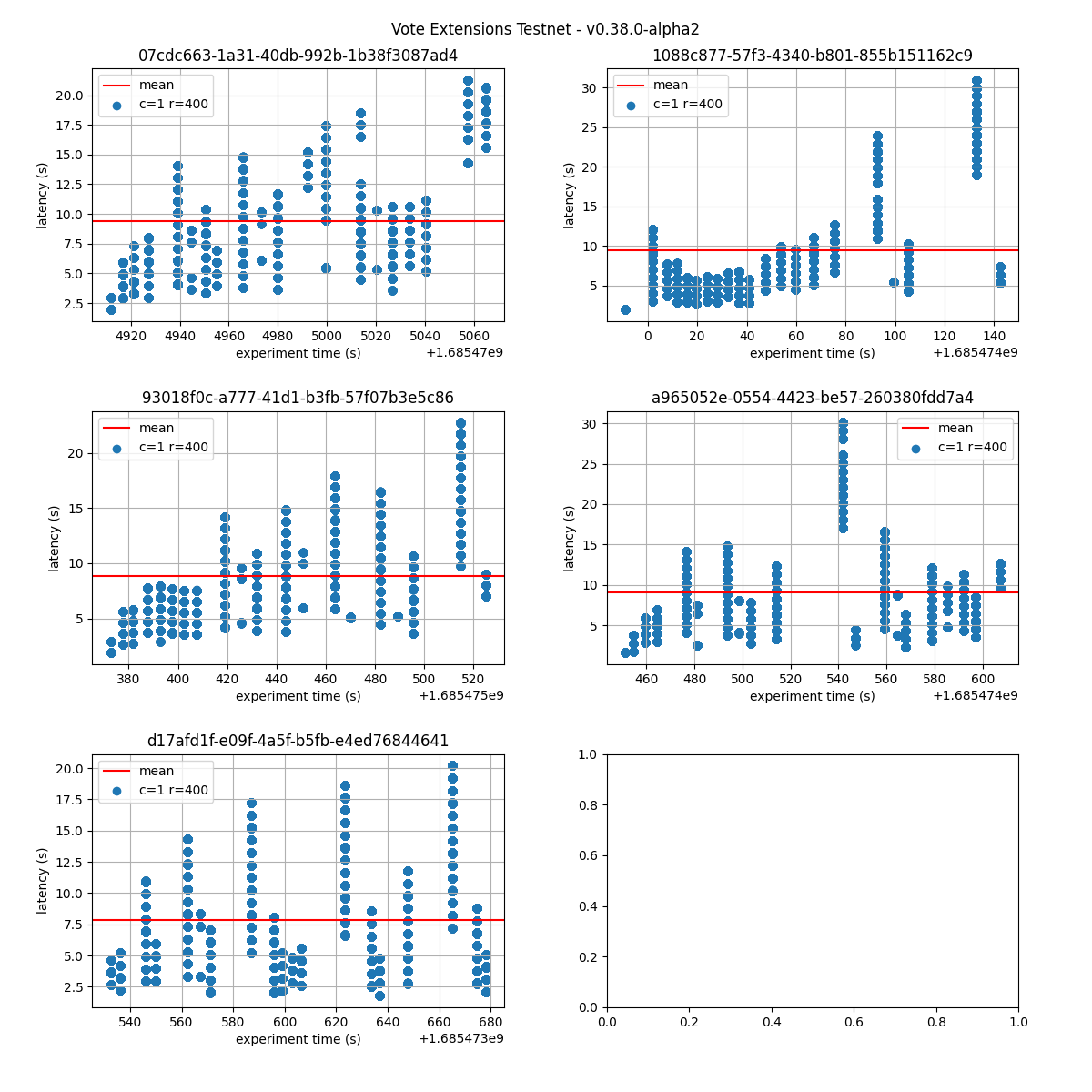
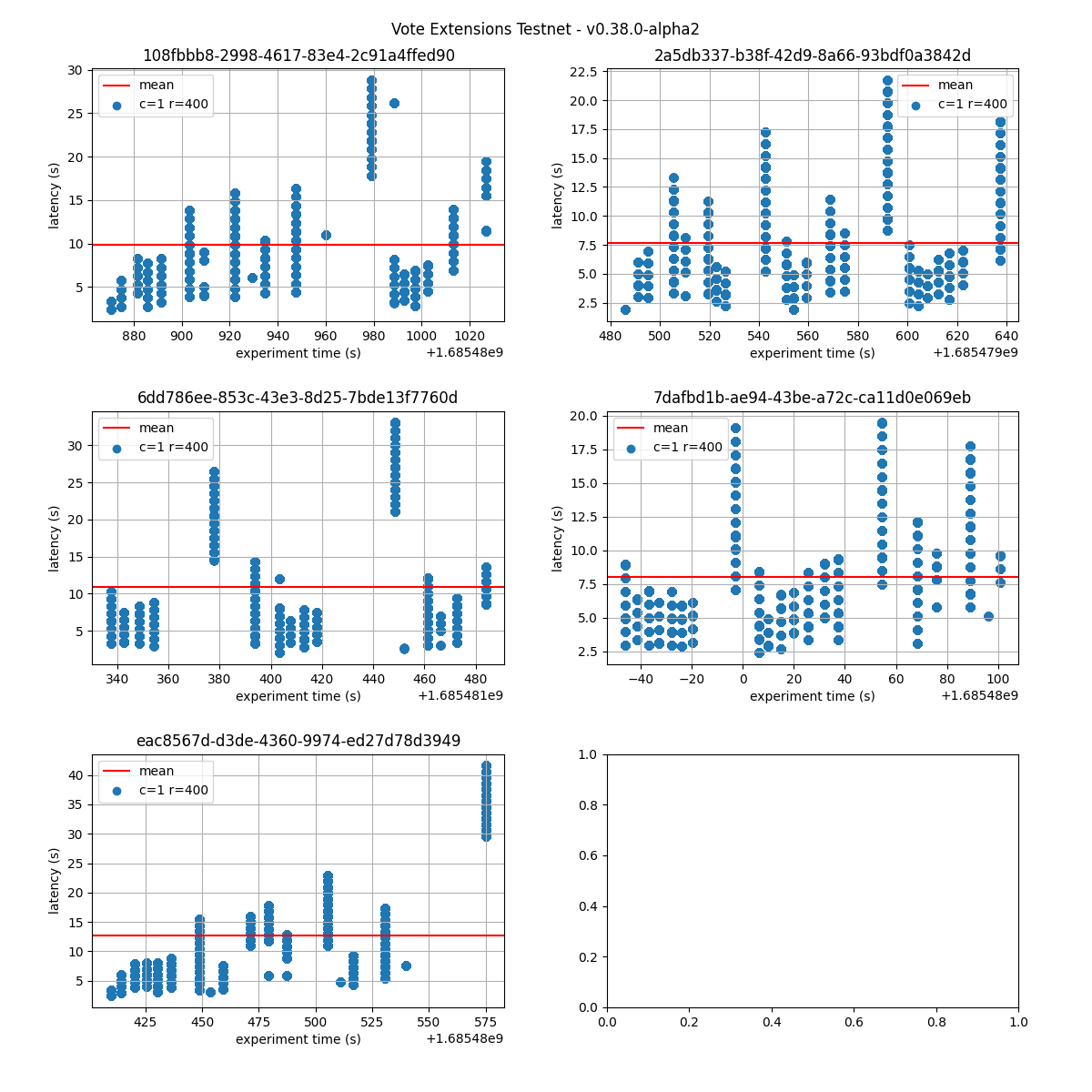
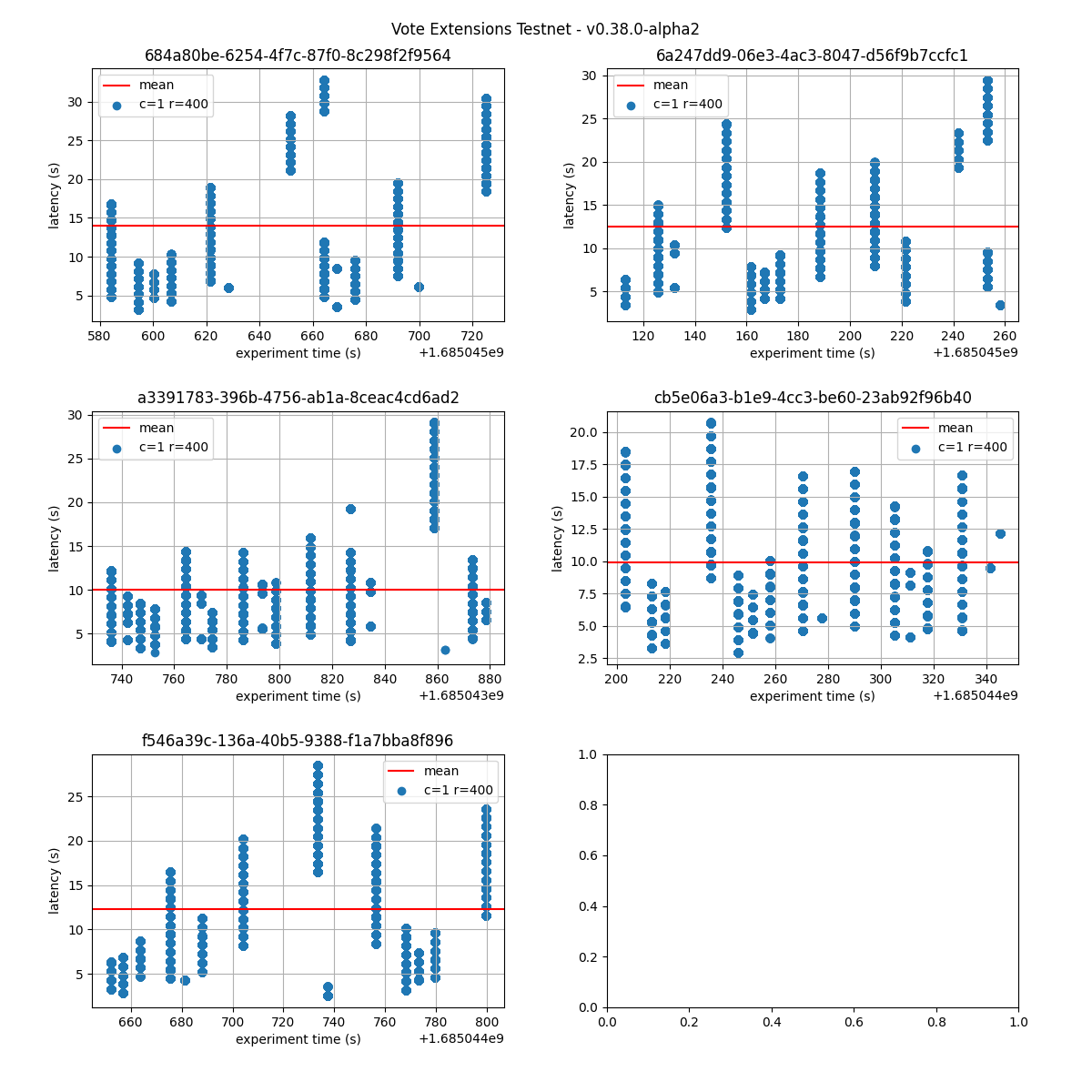
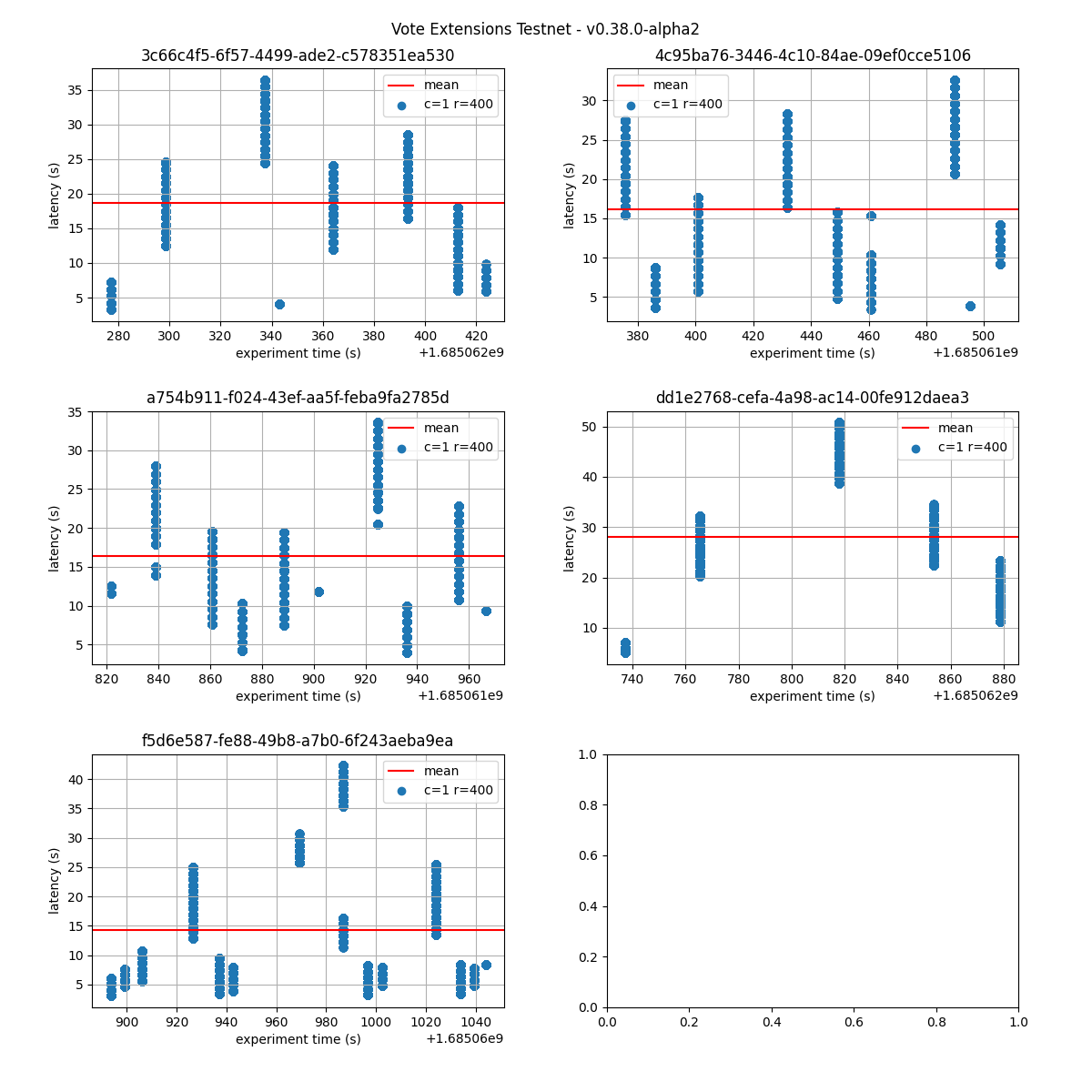
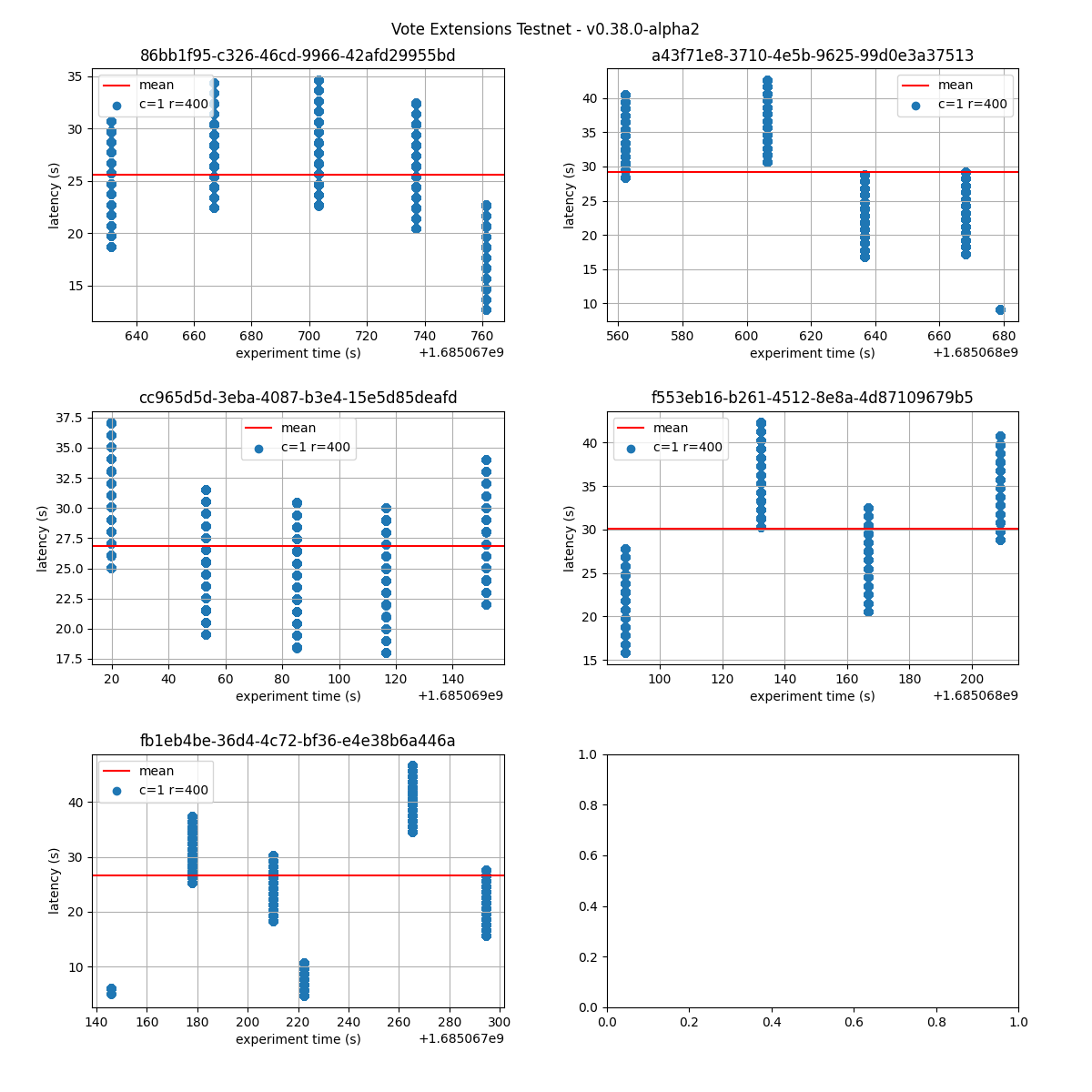
baseline 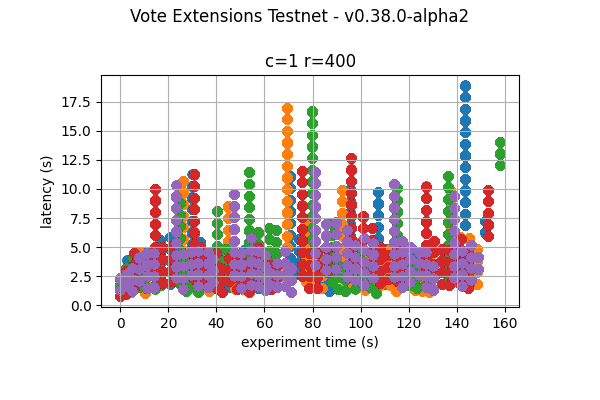 | 2k 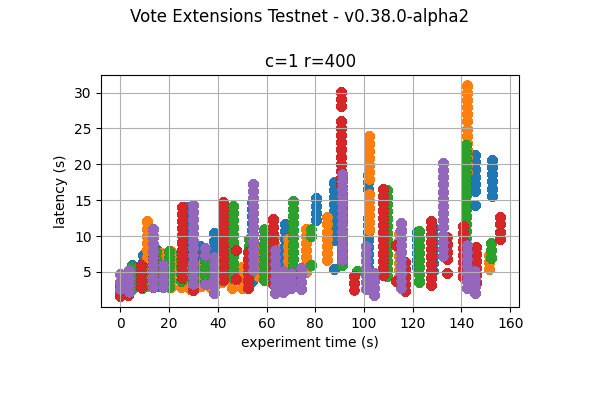 |
4k 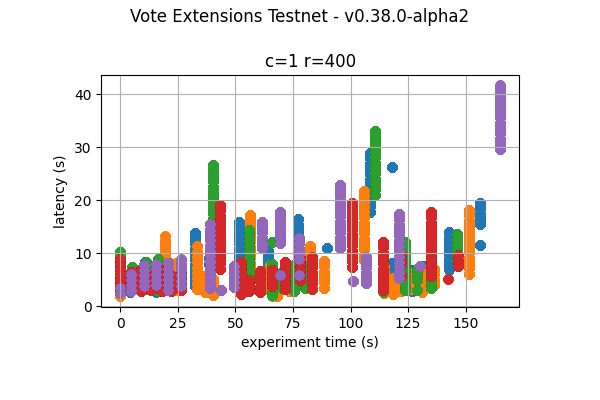 | 8k 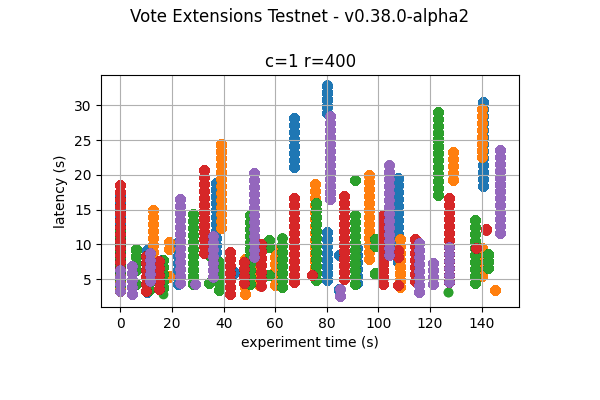 |
16k  | 32k 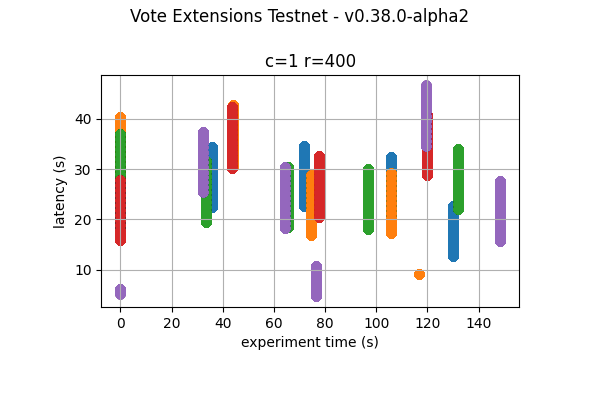 |
Blocks and Transactions per minute
The following plots show the blocks produced per minute and transactions processed per minute. We have divided the presentation in an overview section, which shows the metrics for the whole experiment (five runs) and a detailed sample, which shows the metrics for the first of the five runs. We repeat the approach for the other metrics as well. The dashed red line shows the moving average over a 20s window.Overview
It is clear from the overview plots that as the vote extension sizes increase, the rate of block creation decreases. Although the rate of transaction processing also decreases, it does not seem to decrease as fast.| Experiment | Block creation rate | Transaction rate |
|---|---|---|
| baseline | 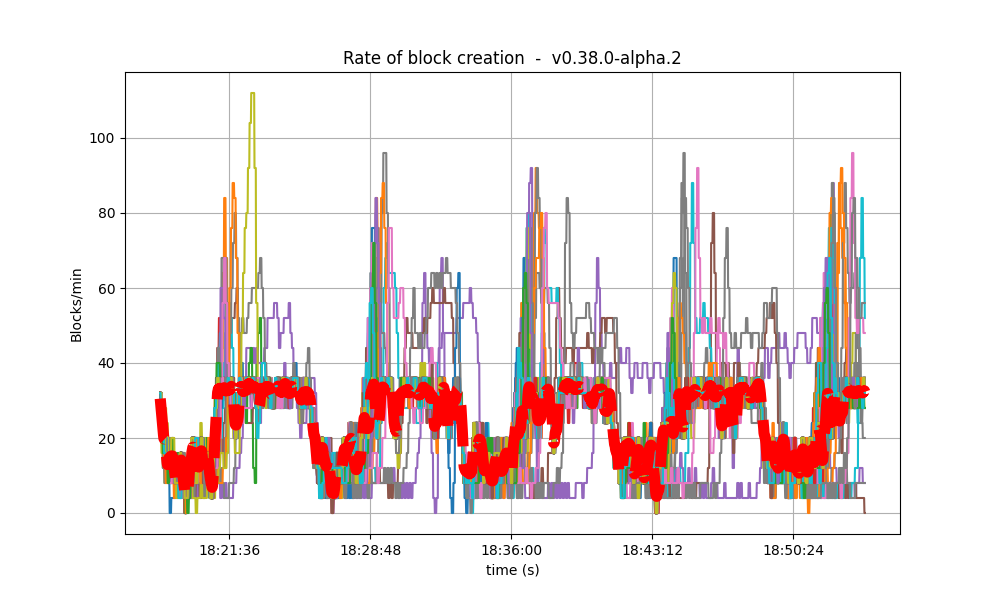 | 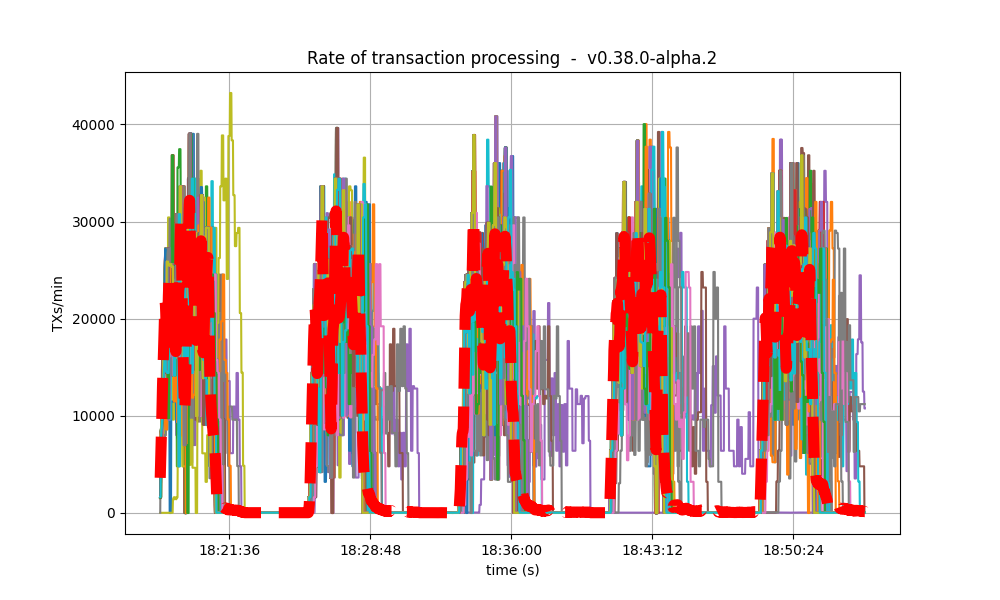 |
| 2k | 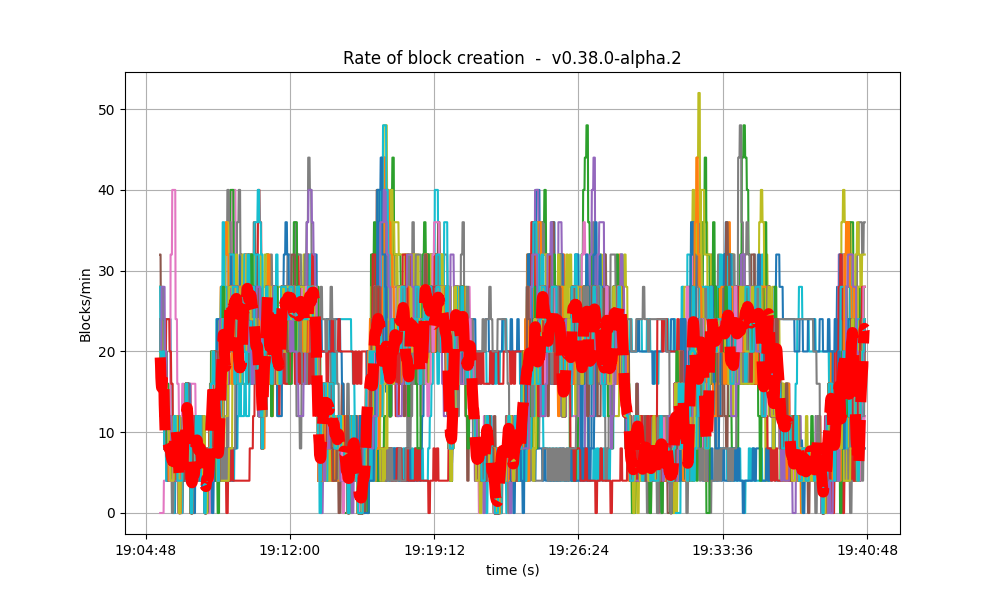 | 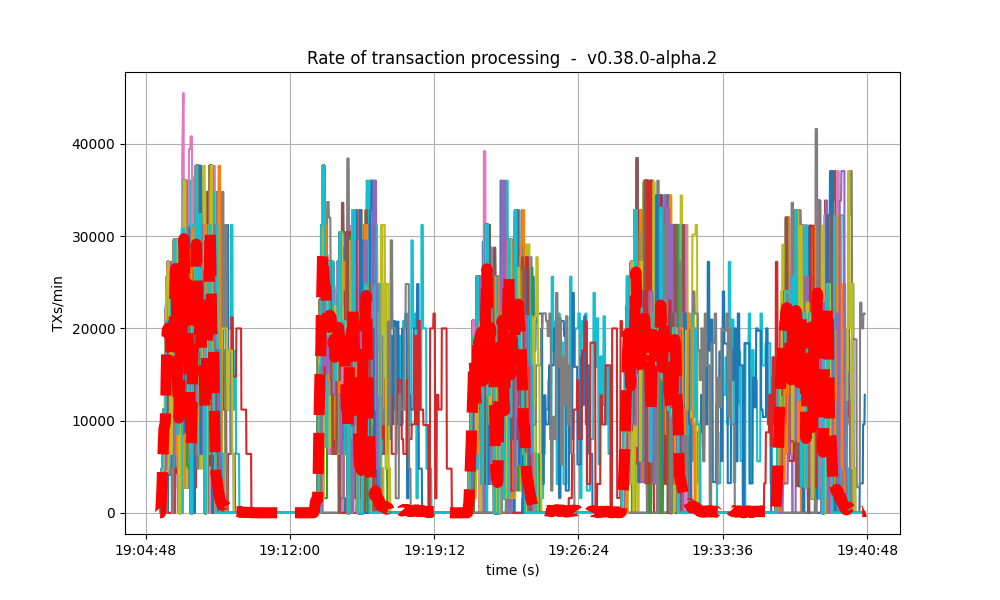 |
| 4k | 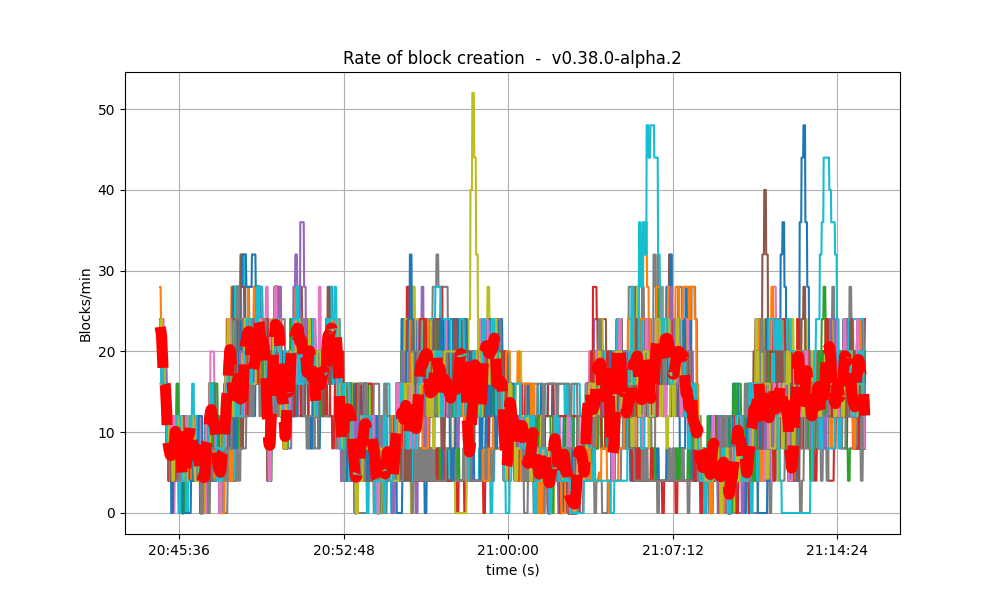 | 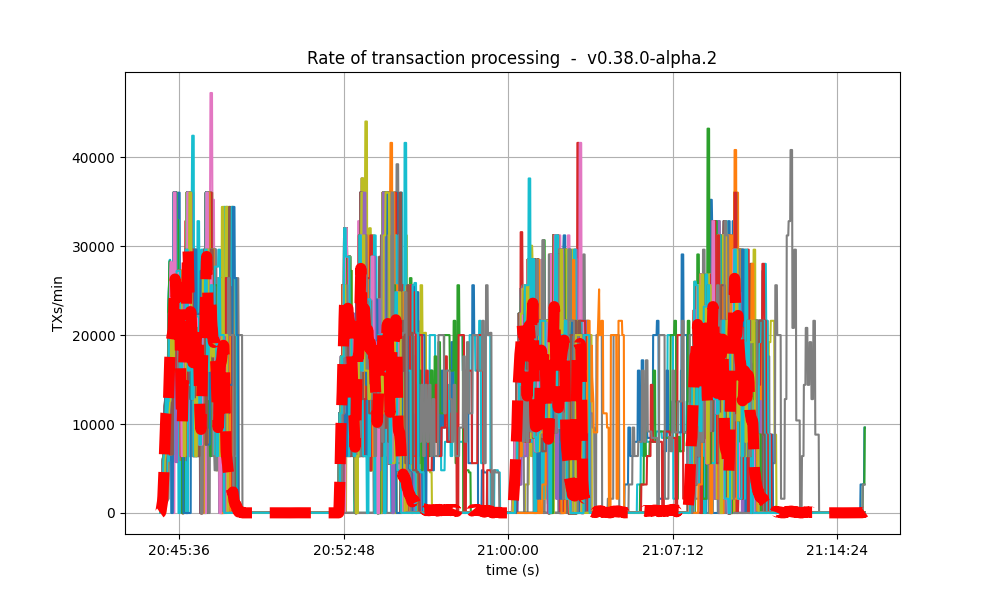 |
| 8k | 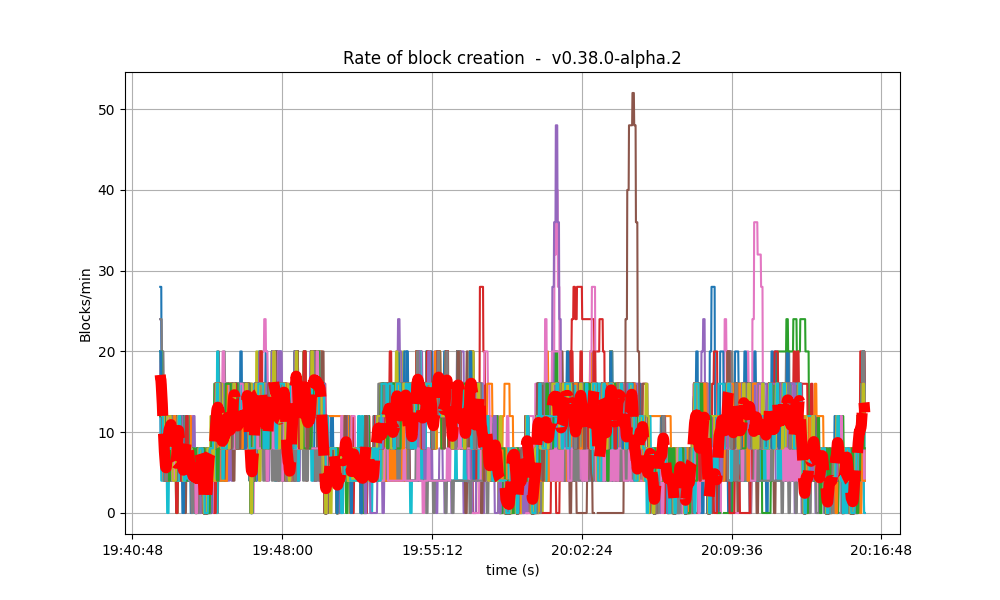 | 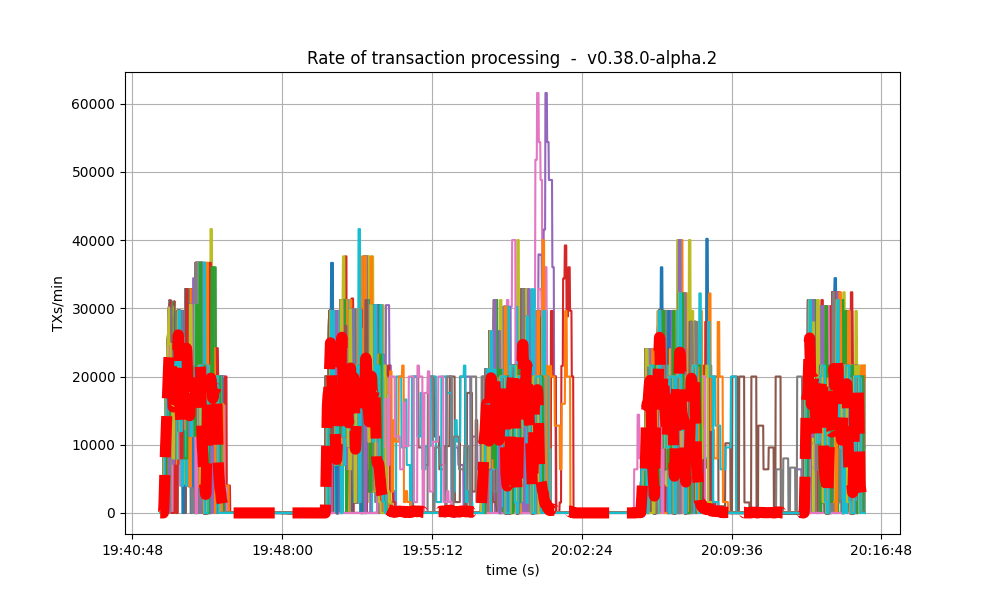 |
| 16k | 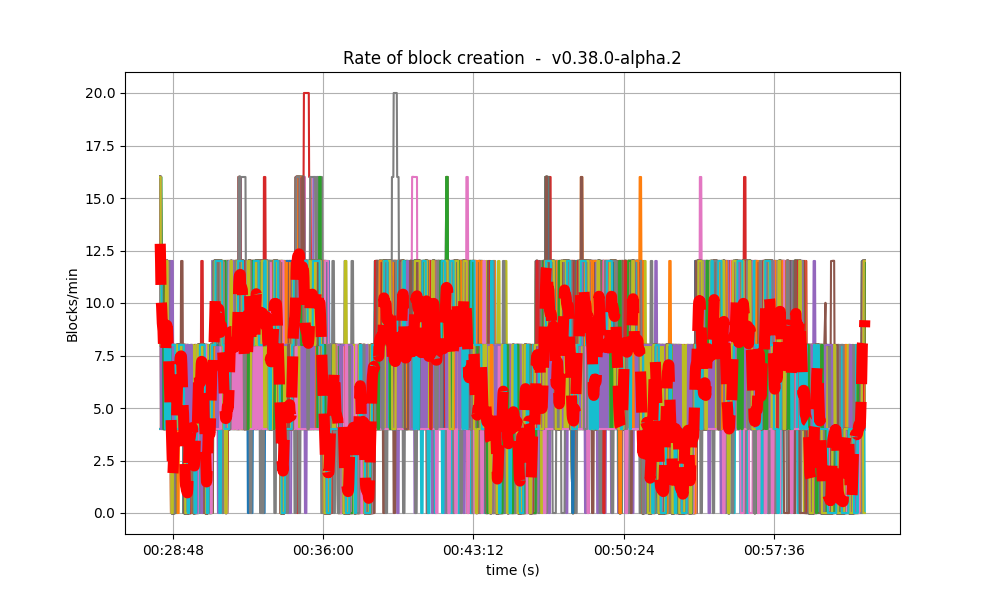 | 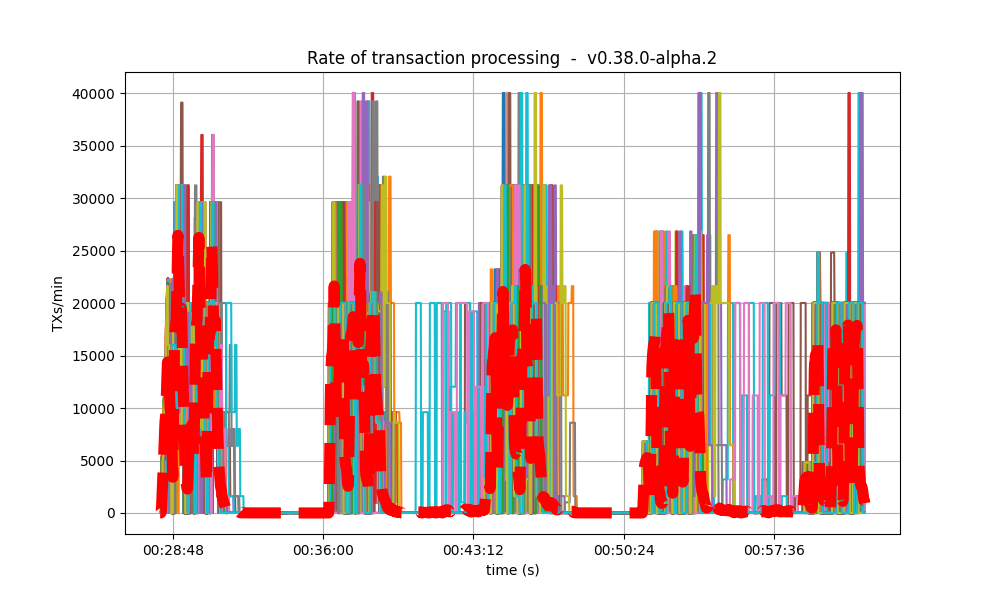 |
| 32k |  | 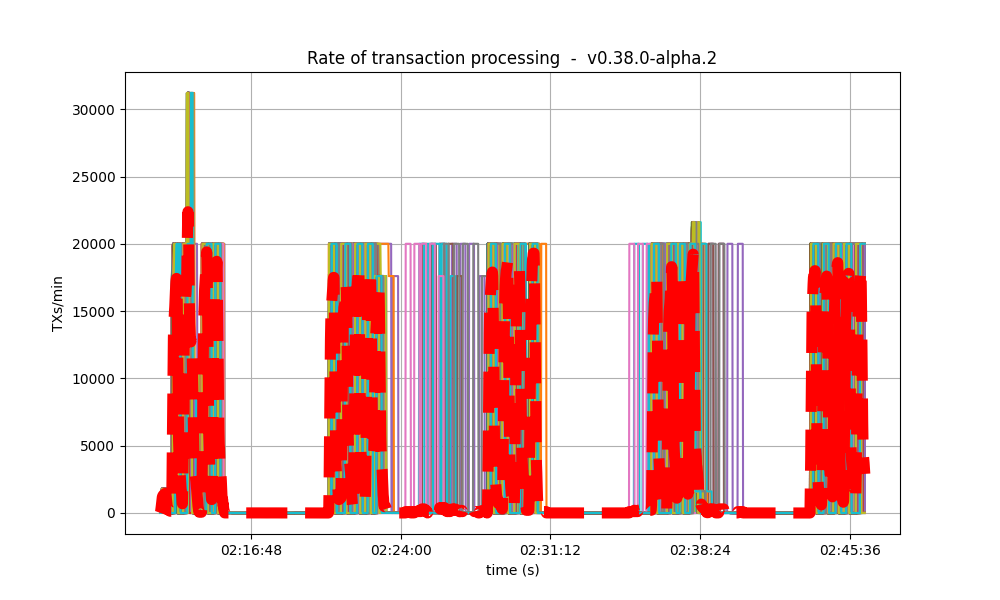 |
First run
| Experiment | Block creation rate | Transaction rate |
|---|---|---|
| baseline | 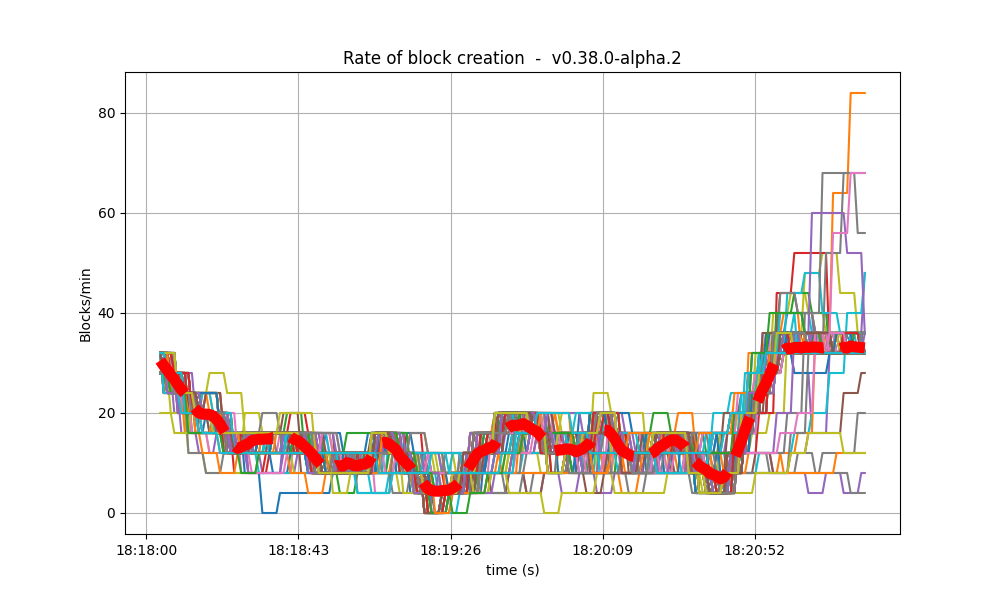 | 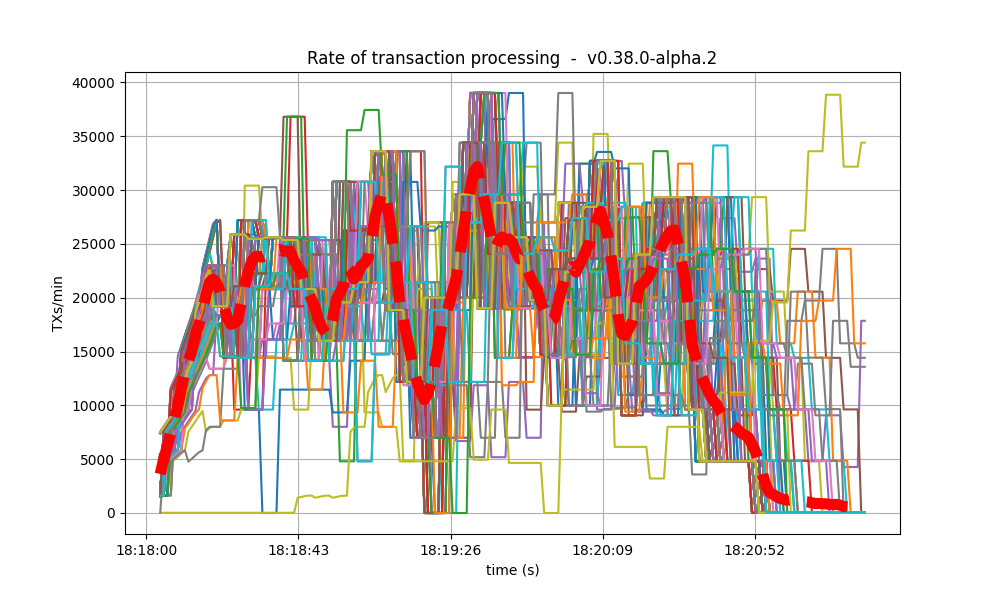 |
| 2k | 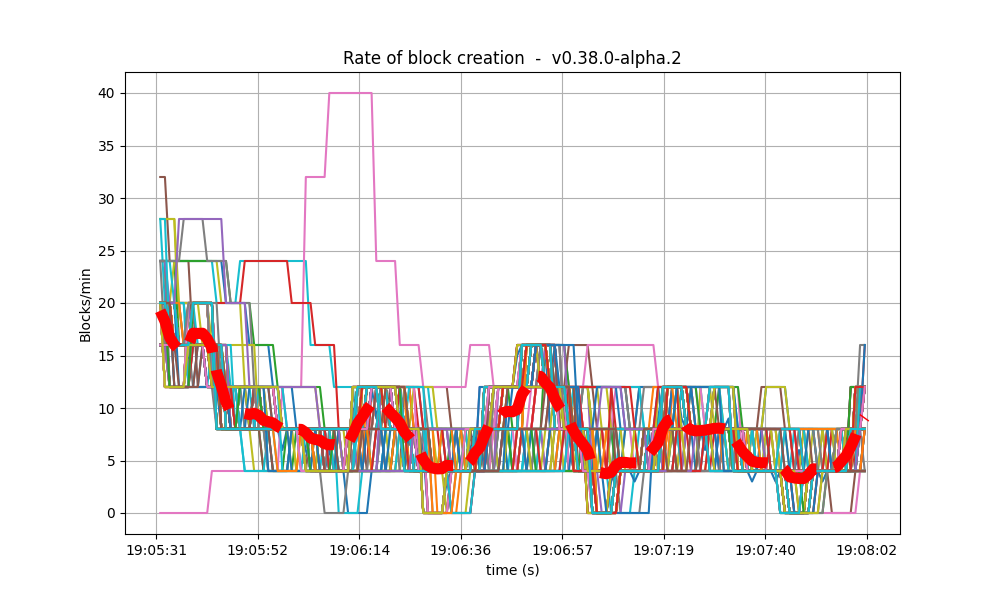 | 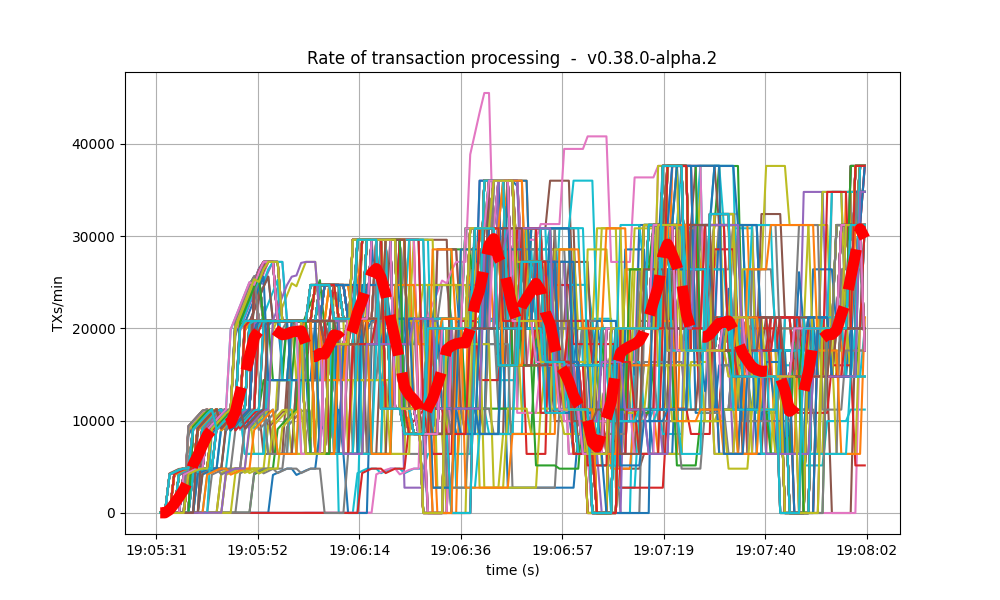 |
| 4k | 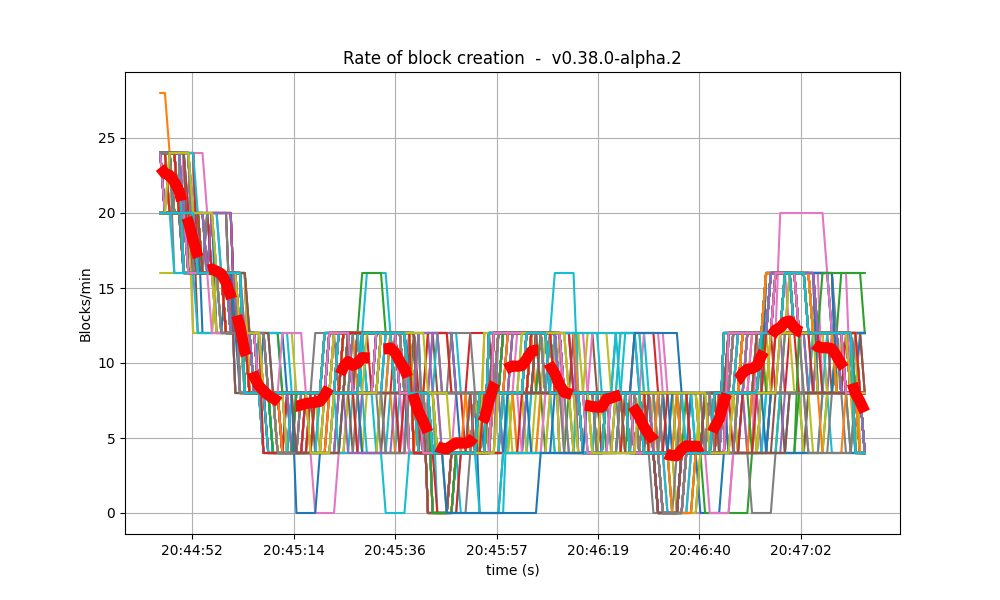 | 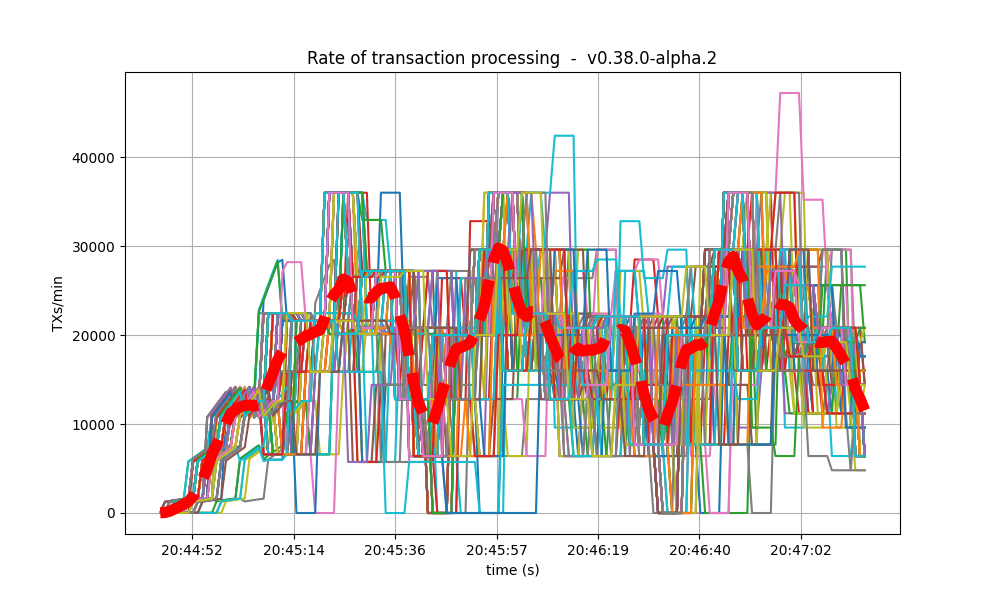 |
| 8k |  | 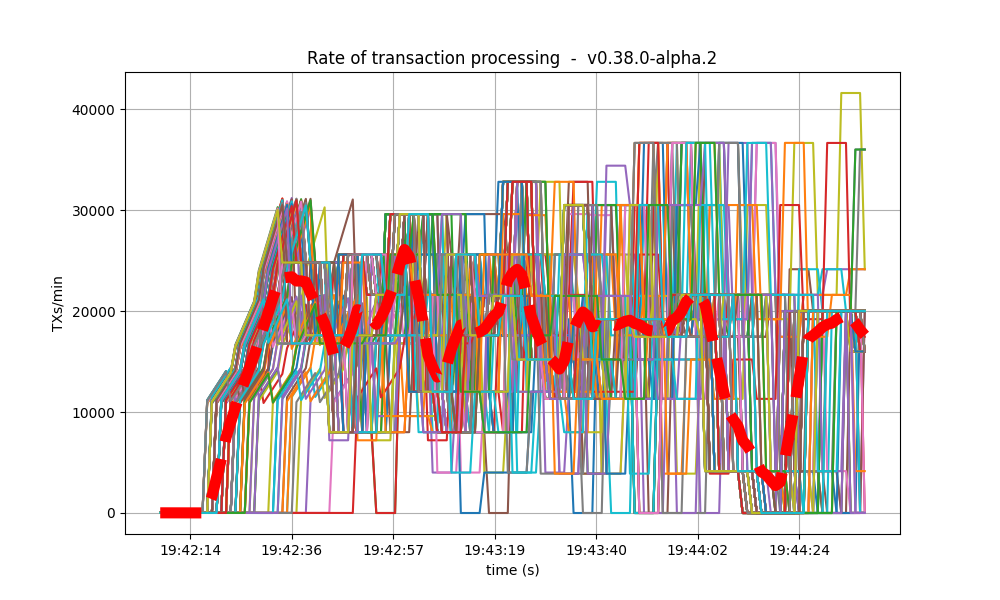 |
| 16k | 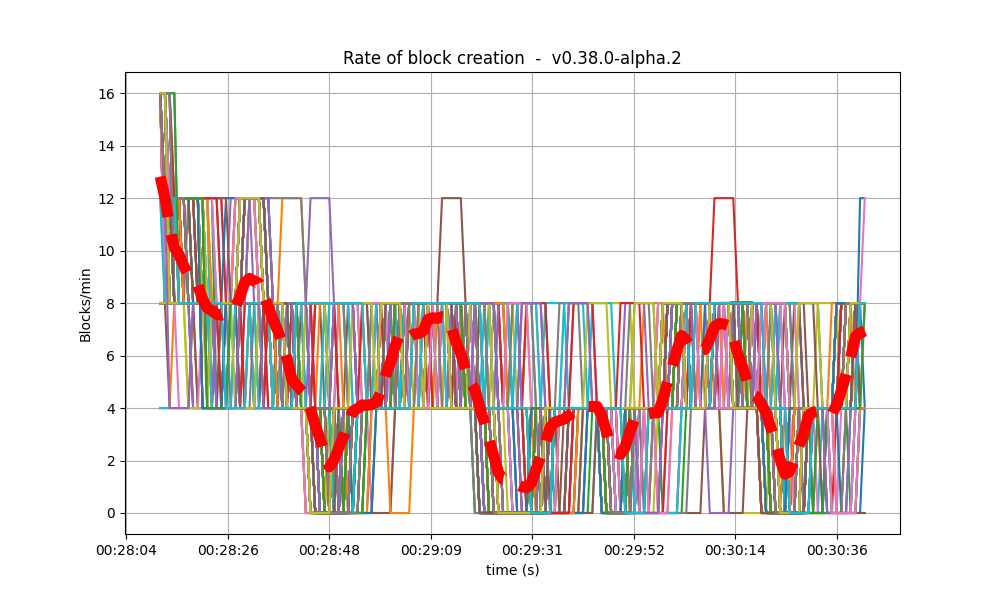 | 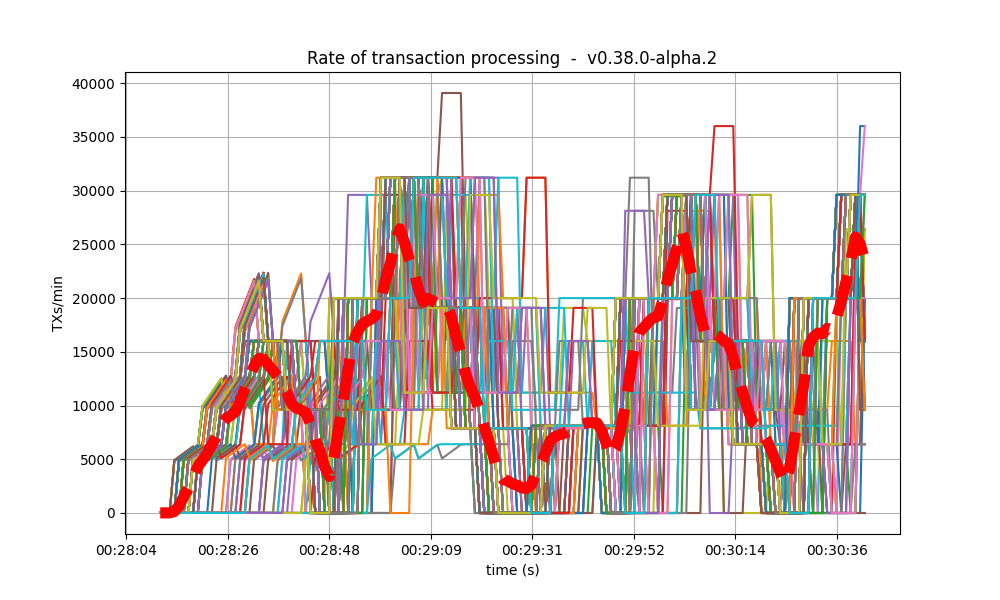 |
| 32k | 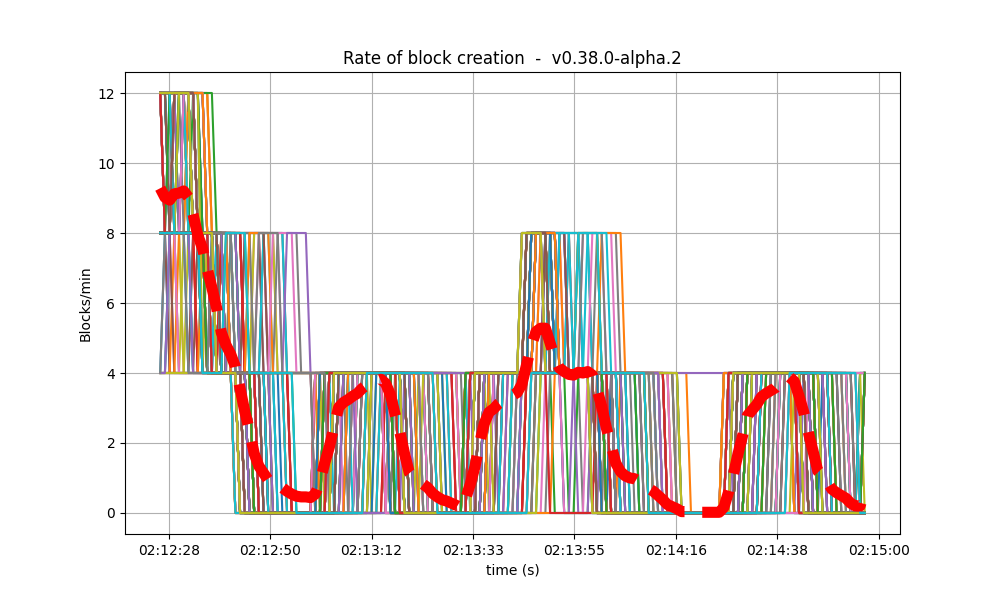 | 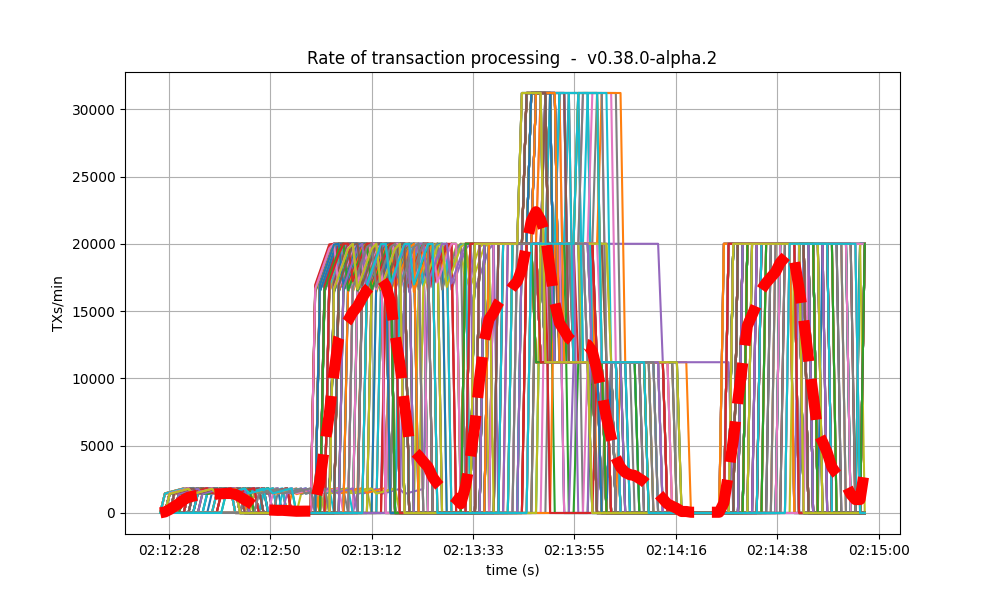 |
Number of rounds
The effect of vote extensions are also felt on the number of rounds needed to reach consensus. The following graphs show the number of the highest round required to reach consensus during the whole experiment. In the baseline and low vote extension lengths, most blocks were agreed upon during round 0. As the load increases, more and more rounds were required. In the 32k case se see round 5 being reached frequently.| Experiment | Number of Rounds per block |
|---|---|
| baseline | 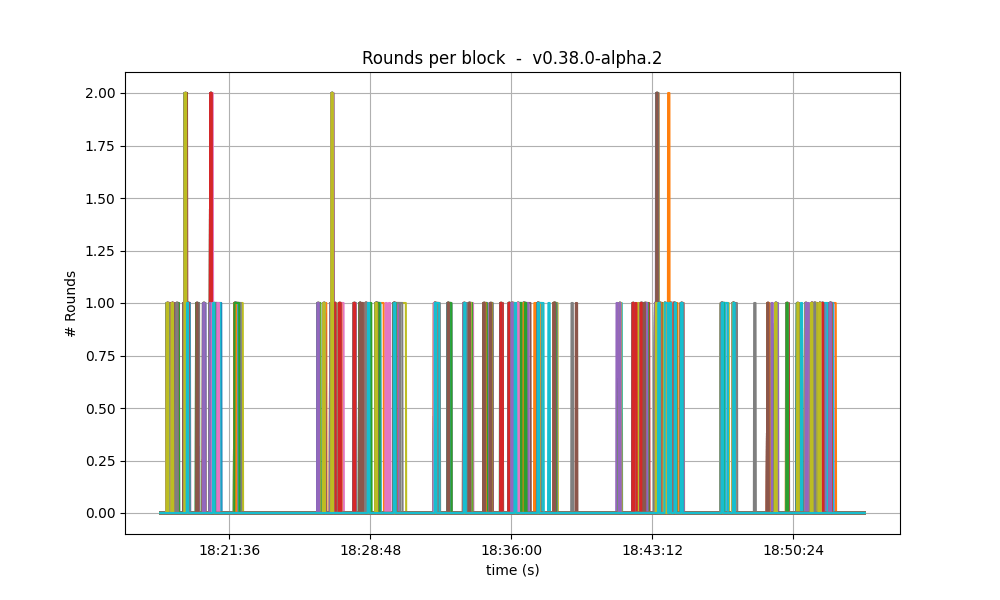 |
| 2k | 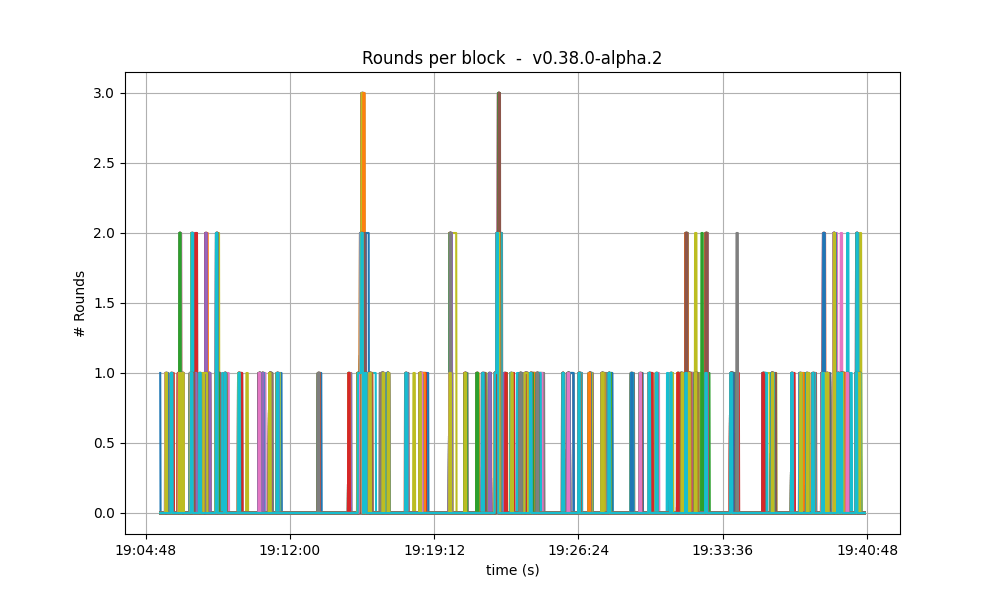 |
| 4k | 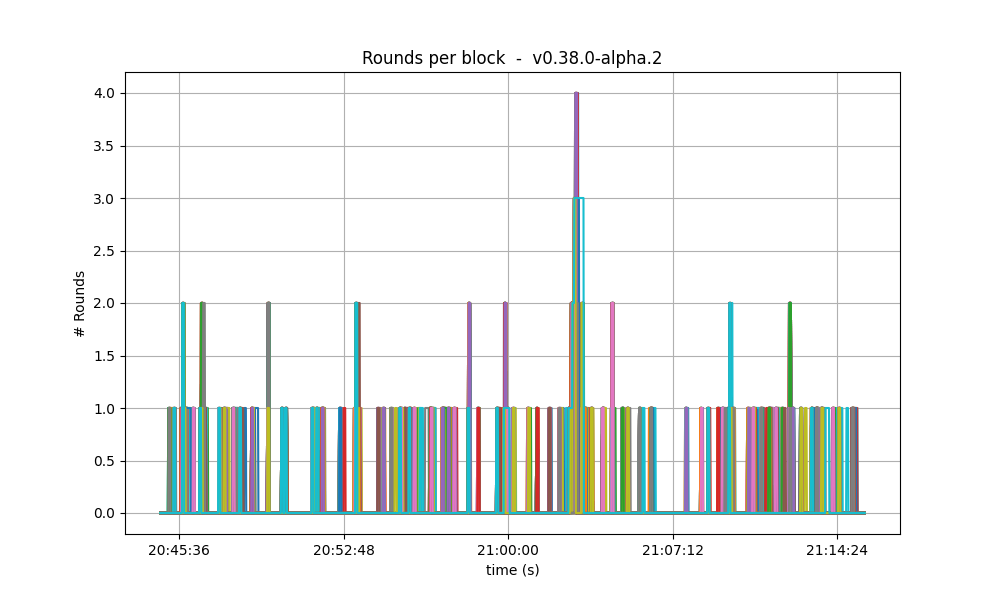 |
| 8k | 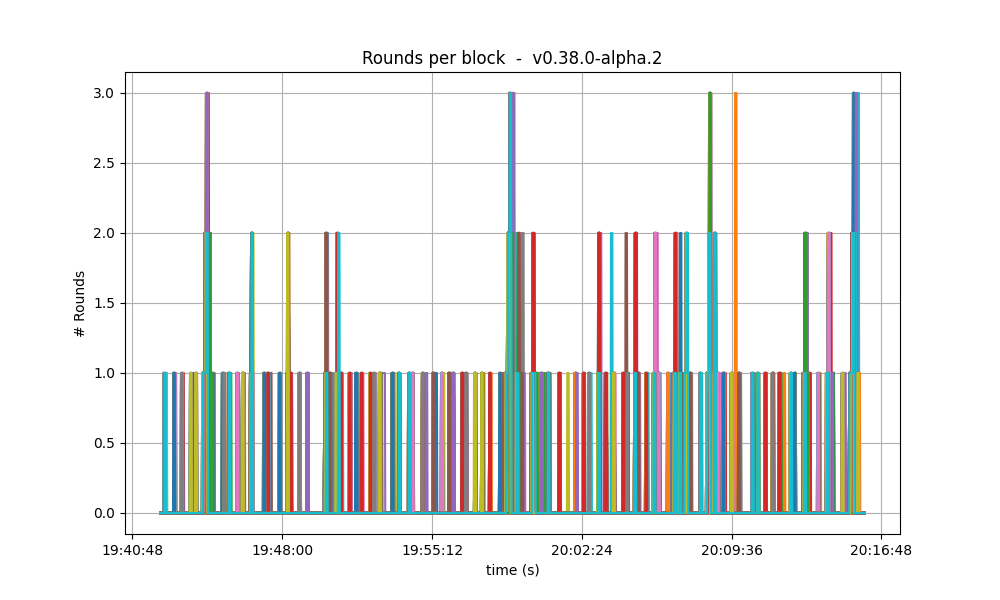 |
| 16k | 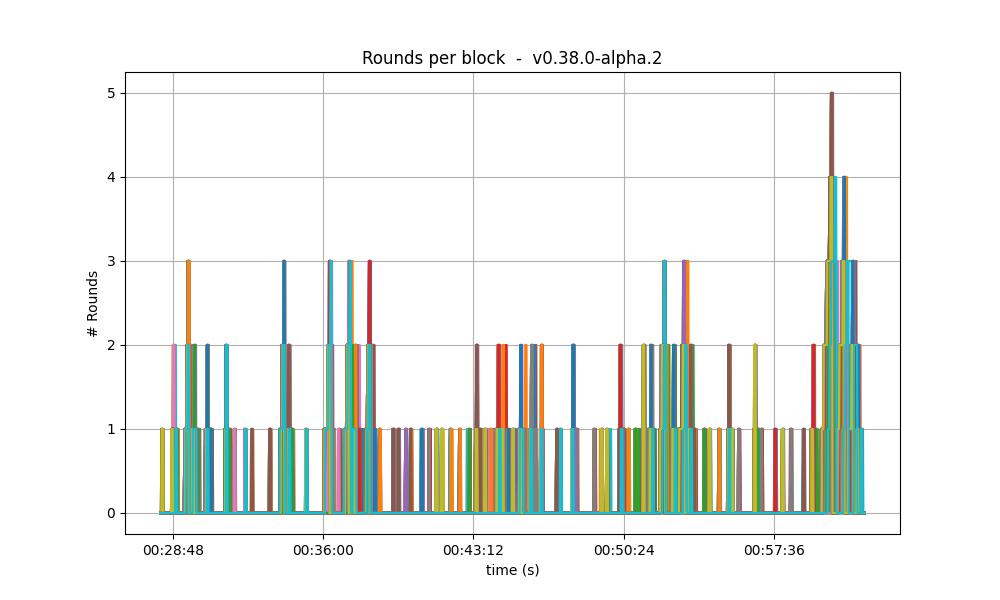 |
| 32k | 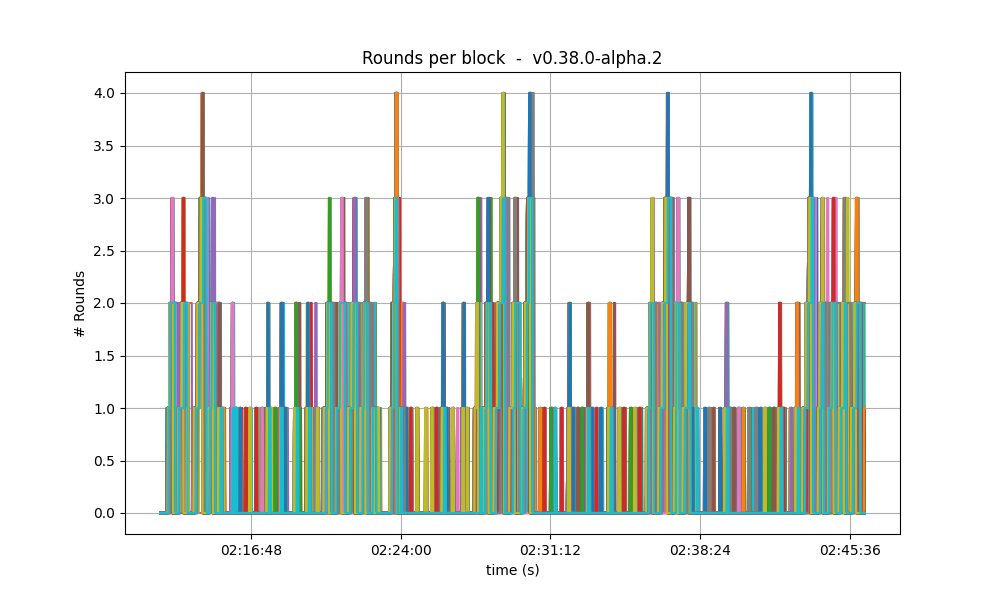 |
CPU
The CPU usage reached the same peaks on all tests, but the following graphs show that with larger Vote Extensions, nodes take longer to reduce the CPU usage. This could mean that a backlog of processing is forming during the execution of the tests with larger extensions.| Experiment | CPU |
|---|---|
| baseline | 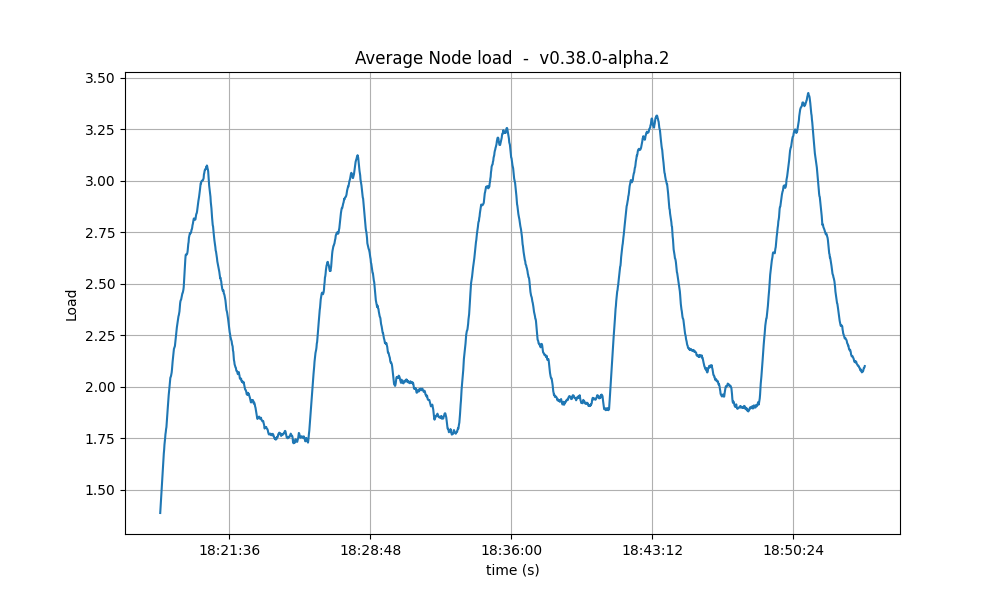 |
| 2k | 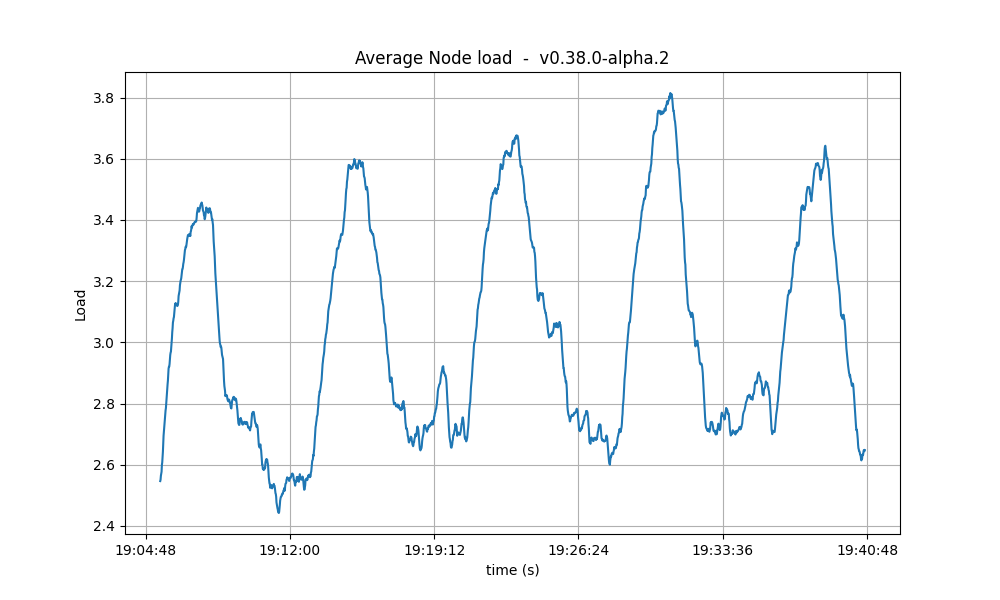 |
| 4k | 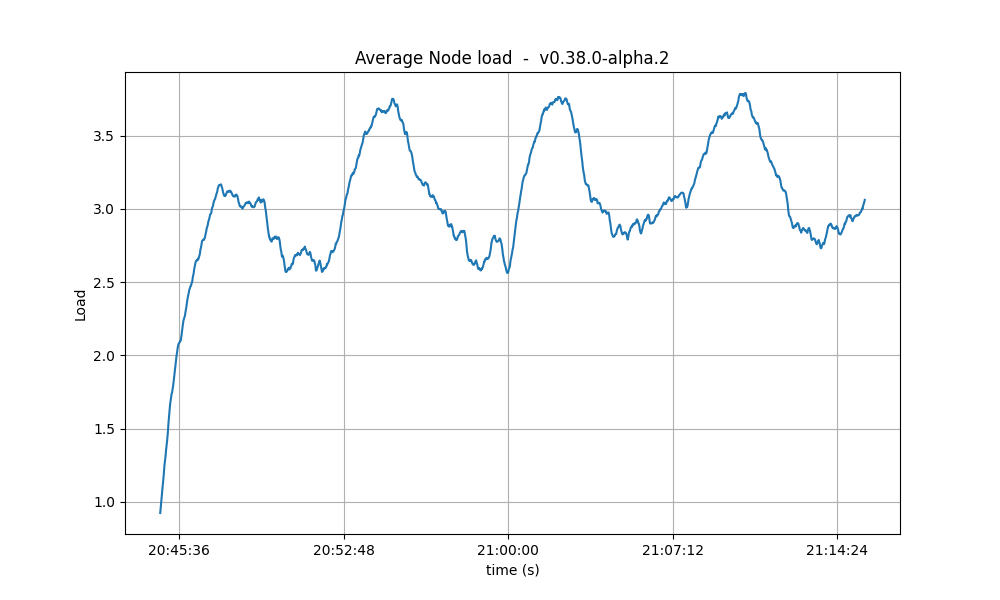 |
| 8k | 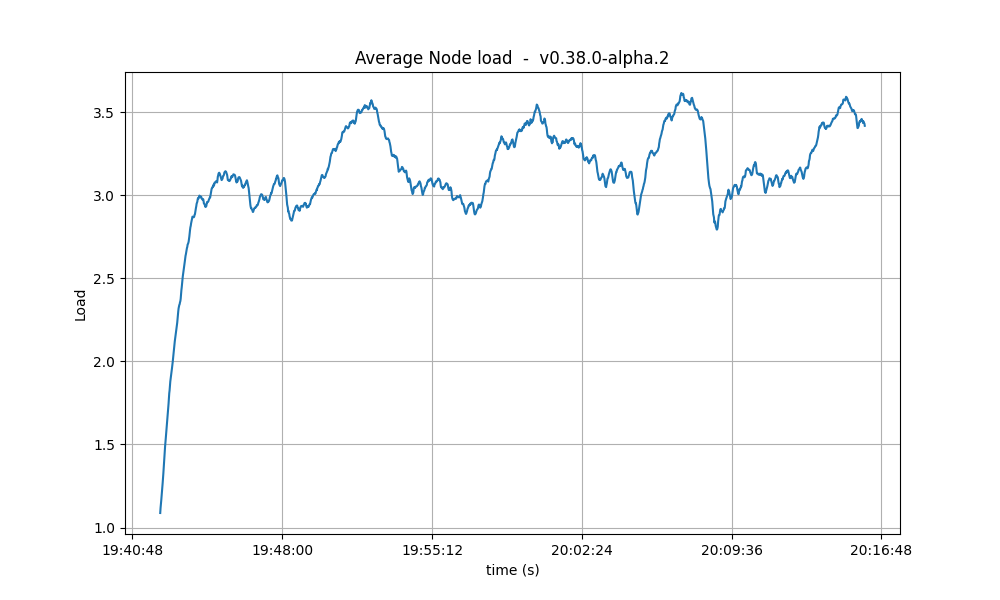 |
| 16k | 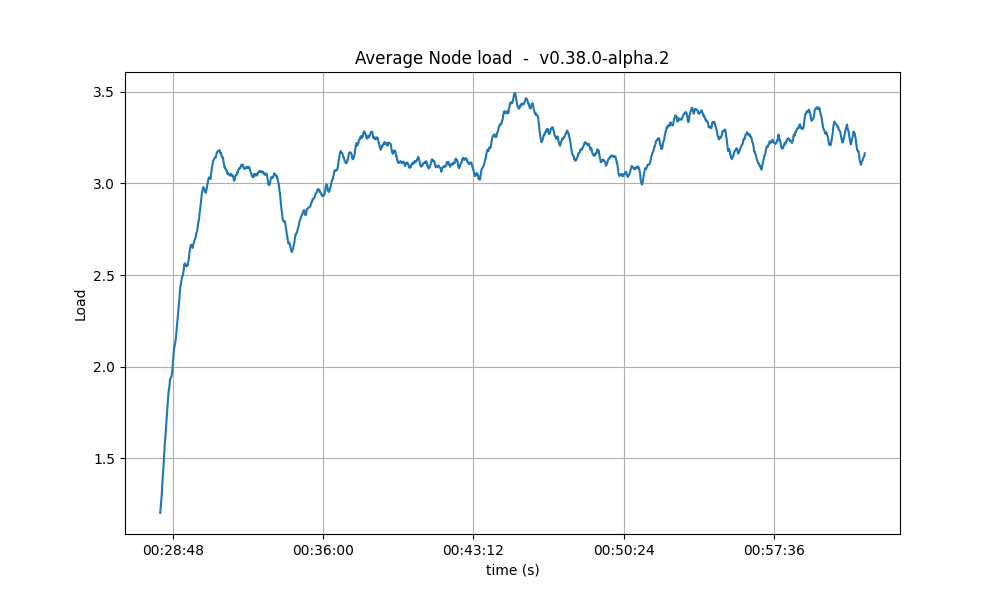 |
| 32k | 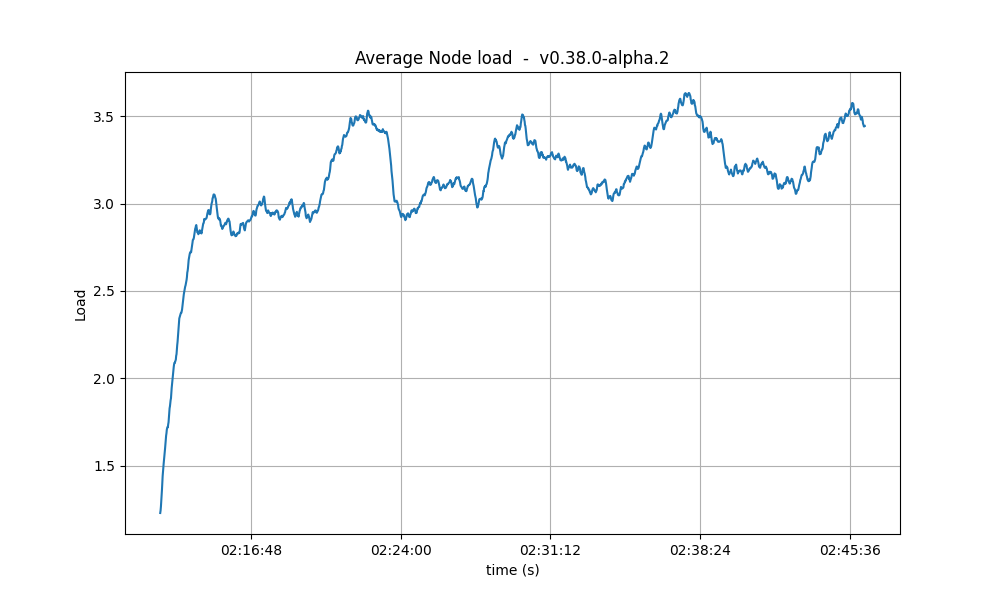 |
Resident Memory
The same conclusion reached for CPU usage may be drawn for the memory. That is, that a backlog of work is formed during the tests and catching up (freeing of memory) happens after the test is done. A more worrying trend is that the bottom of the memory usage seems to increase in between runs. We have investigated this in longer runs and confirmed that there is no such a trend.| Experiment | Resident Set Size |
|---|---|
| baseline | 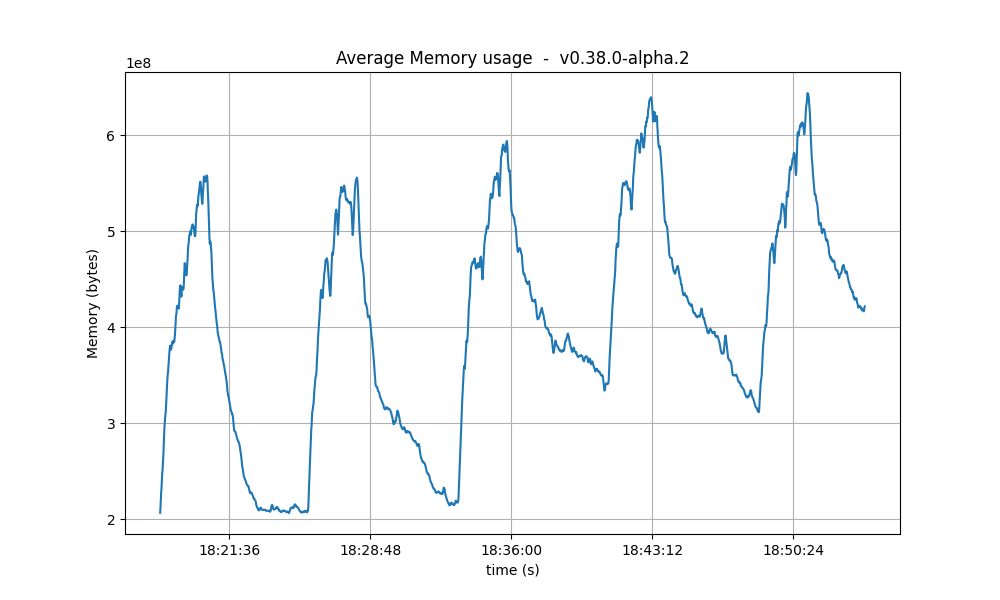 |
| 2k |  |
| 4k | 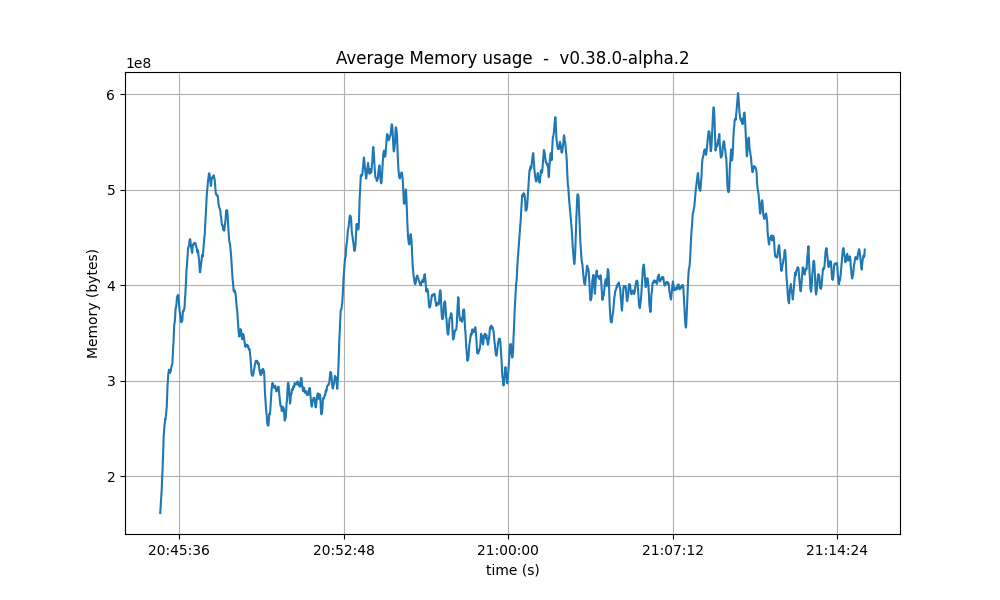 |
| 8k | 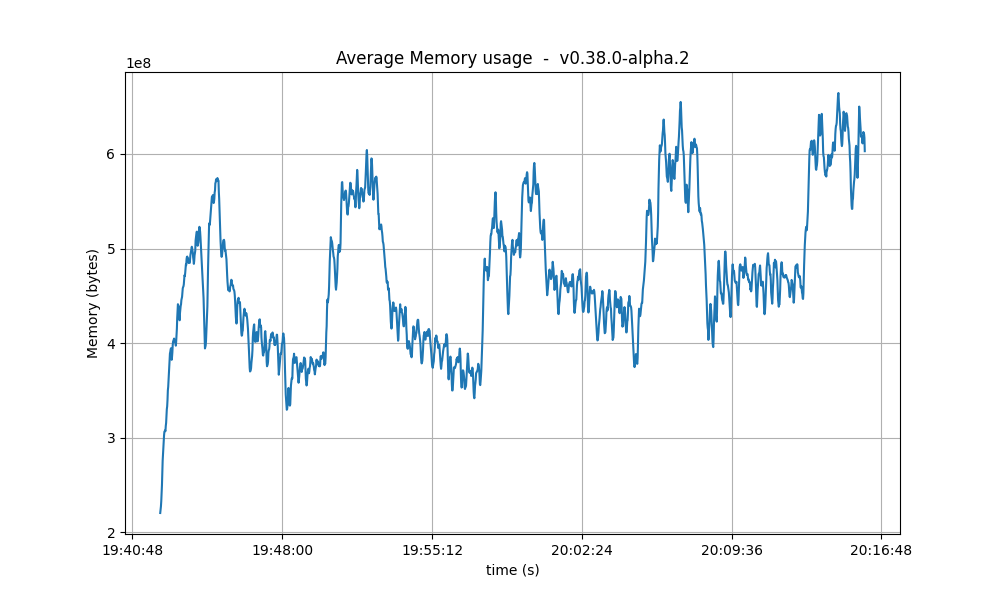 |
| 16k | 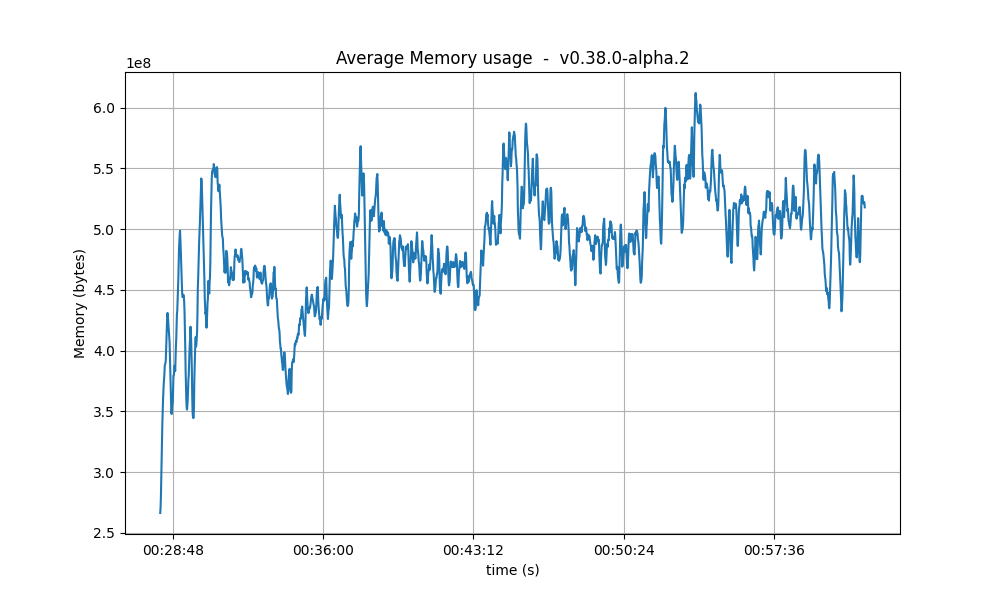 |
| 32k | 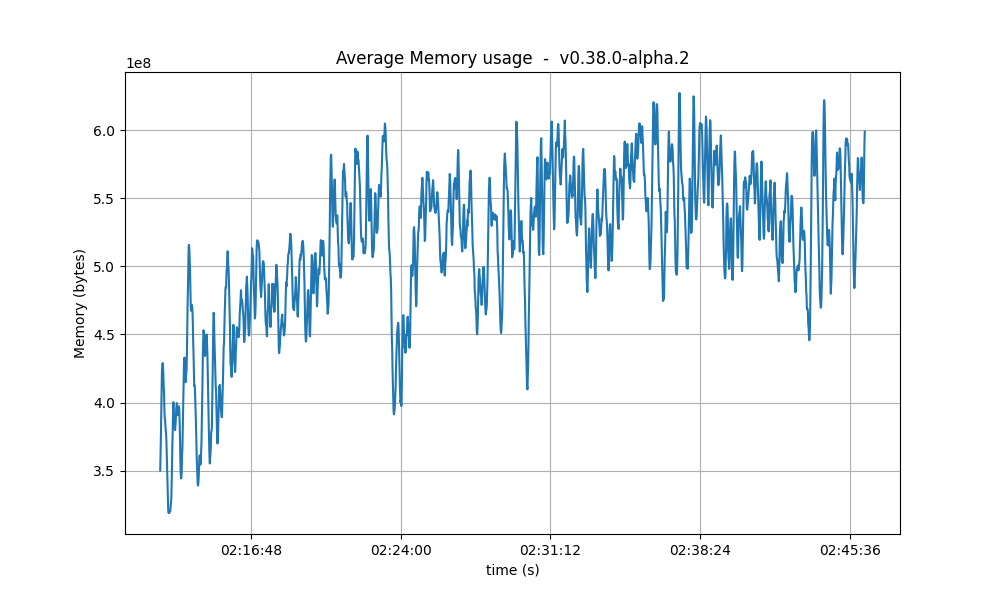 |
Mempool size
This metric shows how many transactions are outstanding in the nodes’ mempools. Observe that in all runs, the average number of transactions in the mempool quickly drops to near zero between runs.| Experiment | Resident Set Size |
|---|---|
| baseline | 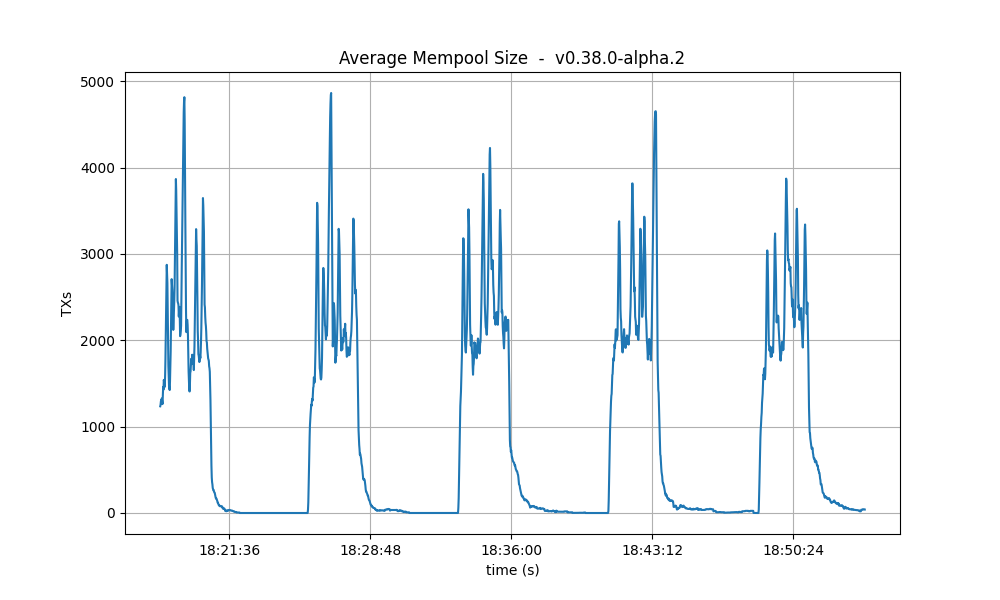 |
| 2k | 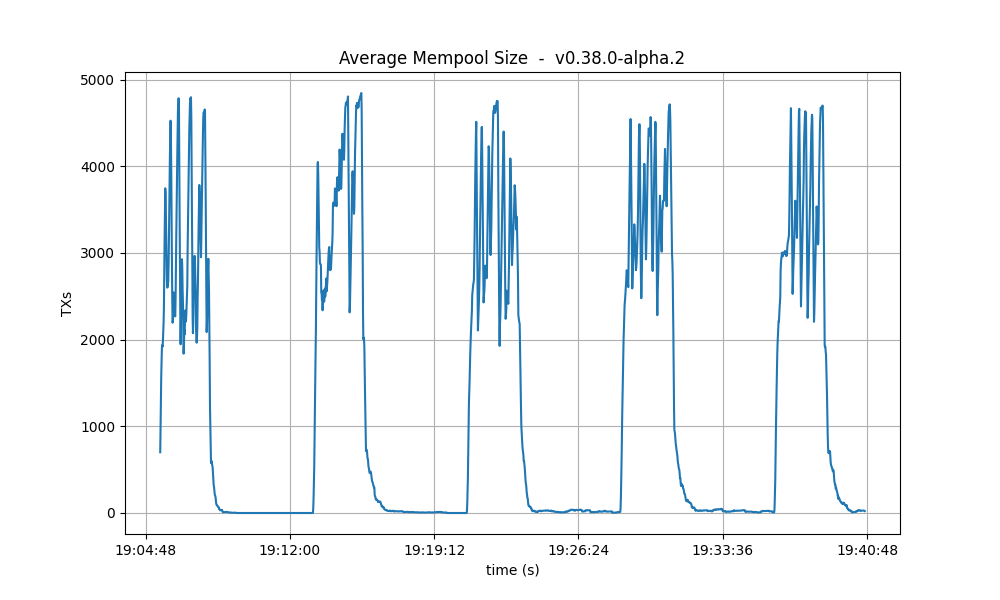 |
| 4k | 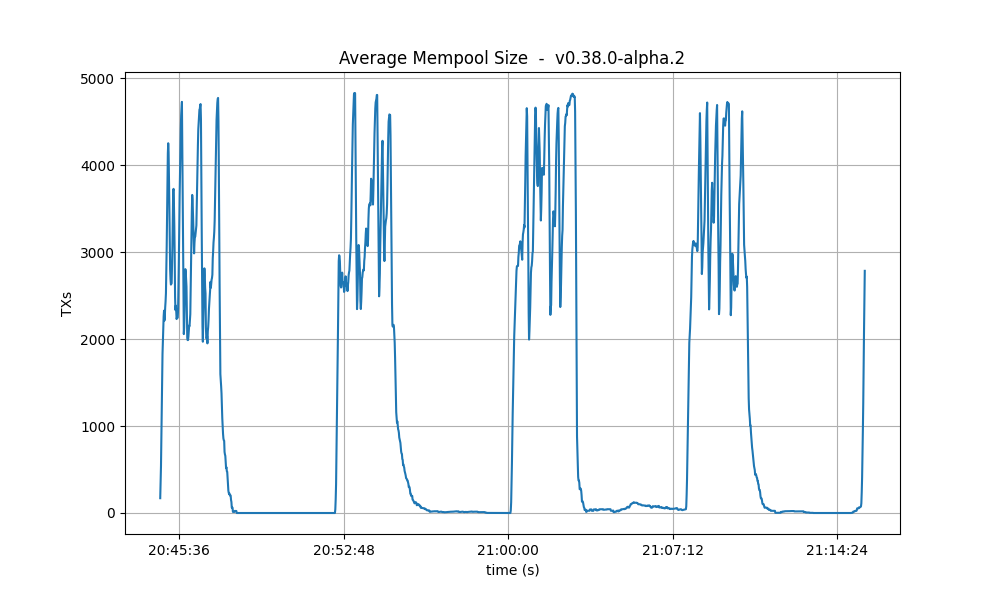 |
| 8k | 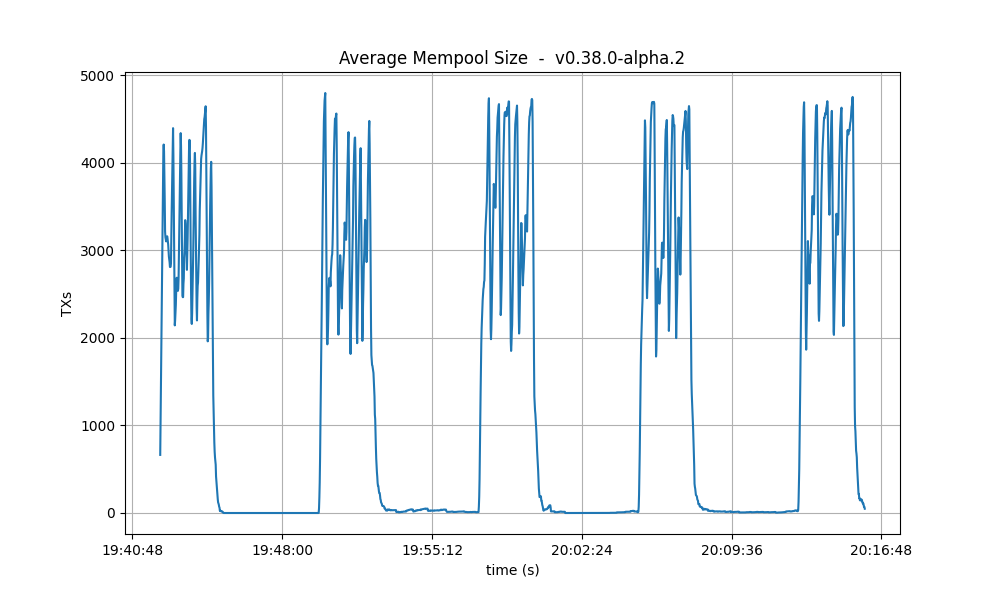 |
| 16k | 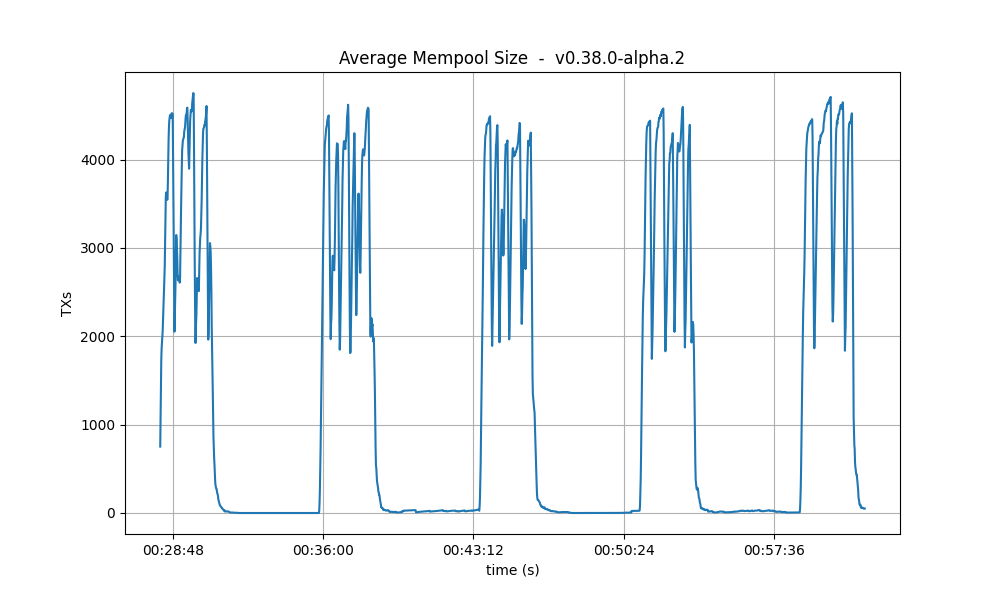 |
| 32k | 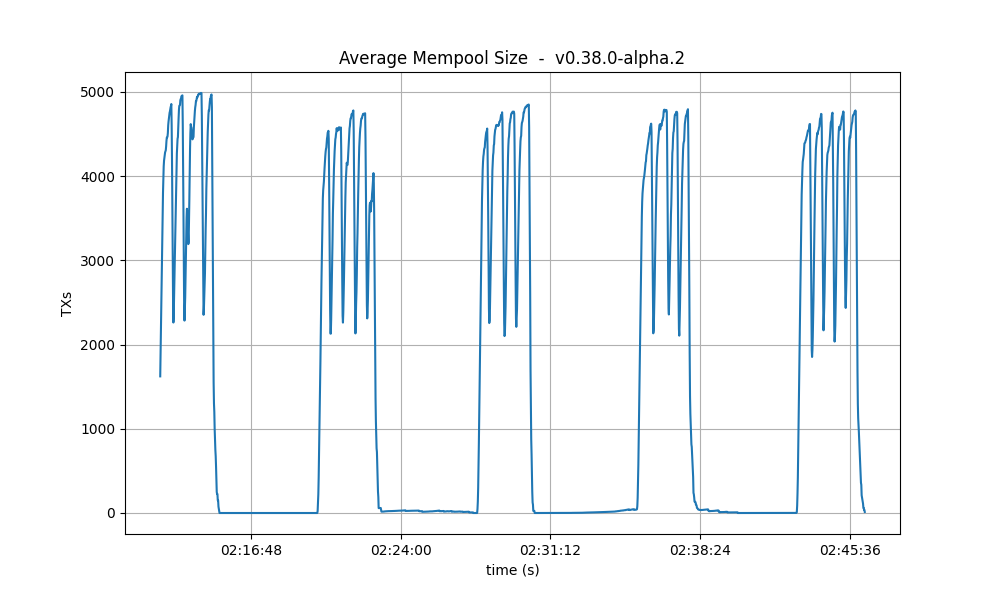 |
Results
| Scenario | Date | Version | Result |
|---|---|---|---|
| VESize | 2023-05-23 | v0.38.0-alpha.2 + varying vote extensions (9fc711b6514f99b2dc0864fc703cb81214f01783) | N/A |